
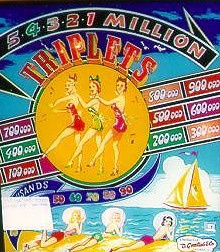
Triplets, released by Gottlieb in 1949, stands as a quintessential artifact of the early post-war era, showcasing the collaborative genius of legendary designer Harry Mabs and iconic artist Roy Parker. As a single-player electro-mechanical machine, it leans heavily into the aesthetic of the time, featuring the vibrant, illustrative character art that defined the golden age of the medium. While it lacks the frenetic, multi-ball chaos of modern machines, the playfield is a study in precision, utilizing a stripped-back geometry that forces the player to contend with the unpredictable physics of a simpler mechanical age.
The layout is defined by its strategic use of bumpers rather than modern complex toys. With a pair of active pop bumpers complemented by a dense array of eight passive bumpers, the machine creates a chaotic, pinball-deflecting environment that demands constant attention. The playfield architecture is further tightened by triple outlane rollovers on both the left and right sides, a punishing design choice that makes ball control an absolute necessity. A single well-placed kick-out hole acts as the primary focal point for scoring, rewarding players who can navigate the bumper garden to find the sweet spot.
With only 750 units confirmed to have left the factory, Triplets remains a sought-after piece for those who appreciate the austere elegance of Gottlieb’s mid-century output. Success on this machine requires a disciplined approach to the flippers; because the passive bumpers are relentless, players should focus on nudging and controlled shots rather than raw power. It is a game of patience and rhythm, serving as a reminder that before the era of deep rulesets and digital displays, the thrill of pinball was found entirely in the raw, tactile struggle between the flipper and the gravity-fed obstacles.