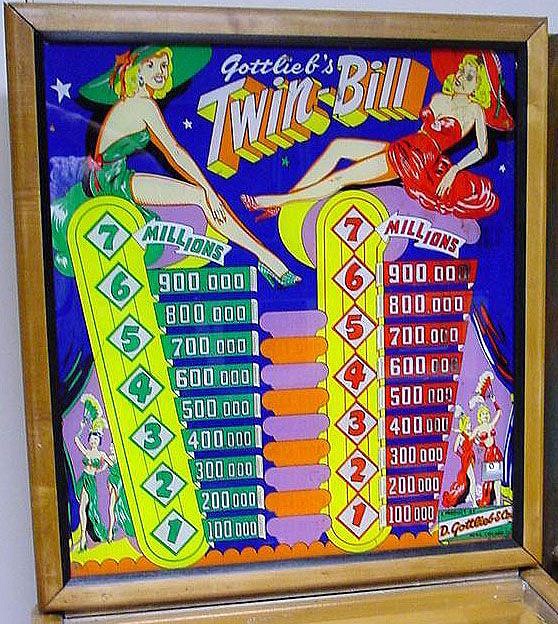
Twin Bill, released by Gottlieb in 1955, stands as a quintessential relic of the early flipper era, masterfully crafted by design legend Wayne Neyens and adorned with the unmistakable, whimsical art of Roy Parker. As a single-player electro-mechanical machine, it captures the raw, stripped-back essence of mid-century arcade gaming. With only 800 units ever produced, it remains a sought-after prize for collectors who appreciate the transition period where pinball moved away from pure chance and toward the skill-based mechanical challenge we recognize today.
The playfield layout is a masterclass in minimalist tension, defined by a pair of flippers, two pop bumpers, and two slingshots that keep the ball in constant, unpredictable motion. The signature “Twin Bill” experience is anchored by its two iconic gobble holes, which act as high-stakes gravity wells that demand precision shooting. Unlike modern tables that rely on complex ramps and subways, this machine forces players to master the art of the nudging and the dead-pass, as the geometry of the playfield is unforgiving and the action is lightning-fast.
For those looking to conquer this classic, the primary strategy revolves around controlling the ball’s rhythm to navigate the gobble holes while capitalizing on the pop bumpers for scoring bursts. Because the game lacks the deep rulesets of later decades, success is entirely dependent on your ability to read the ball’s trajectory and react to the frantic, mechanical clatter of the playfield. It is a stark, elegant reminder of Gottlieb’s golden age, proving that you don’t need a hundred modes to create an experience that feels like a genuine test of nerves.