
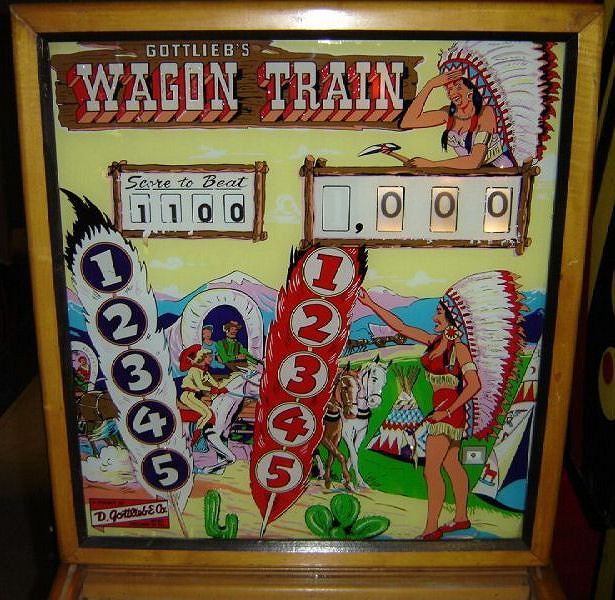
Wagon Train, released by Gottlieb in 1960, stands as a quintessential artifact of the Electromechanical era, bearing the unmistakable fingerprints of legendary designer Wayne Neyens and artist Roy Parker. Rooted in the rugged aesthetic of the American West, this single-player machine is a masterclass in the minimalist, high-tension gameplay that defined the mid-century arcade experience. Without the distraction of modern digital displays or complex rulesets, the game relies on its stark, period-accurate artwork and the rhythmic clatter of score reels to transport the player to the frontier.
The mechanical heart of the machine is built around two roto-targets, which act as the primary navigational focal points for the player. These rotating banks demand precise aim, forcing you to navigate through a trio of pop bumpers and a pair of active slingshots that keep the ball in constant, unpredictable motion. Because the playfield layout is focused on these rotating targets, success requires a patient, rhythmic approach to flipper control rather than the rapid-fire style found in modern titles.
With only 1,100 units produced, Wagon Train is a sought-after piece for collectors who appreciate the tactile satisfaction of vintage pinball. The strategy here is stripped to its barest, most difficult essentials: managing the ball’s trajectory around the roto-targets while maintaining control off the two flippers. It is a game of endurance and focus, serving as a reminder that before the era of light shows and deep software, the true challenge of the game was simply mastering the geometry of the table.