
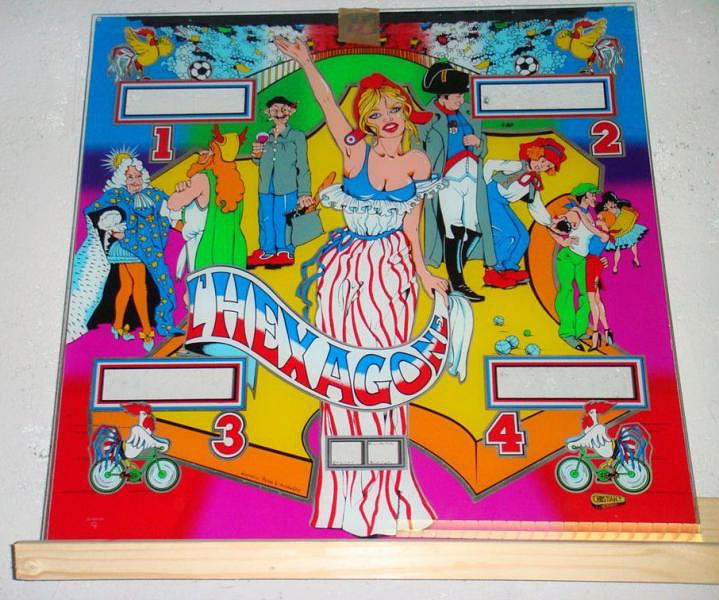
L’Hexagone, a rare solid-state conversion kit produced by K.C. Tabart, stands as a curious artifact of European pinball history. With only 150 units confirmed to exist, this machine is a true deep-cut for collectors who appreciate the niche ingenuity of 1980s conversion culture. Featuring artwork by Agnès G., the playfield is deceptively dense, utilizing three flippers and a specialized “Action Ring” to navigate a layout that prioritizes mechanical precision over flashy gimmicks. It is a machine that demands disciplined play, as it lacks the forgiveness of modern titles and punishes reckless nudging with a sensitive tilt mechanism.
The entire ecosystem of L’Hexagone revolves around the pursuit of a massive end-of-ball bonus. The strategy is straightforward but demanding: players must aggressively target the upper left drop targets and the spinning target to inflate their base bonus value, while keeping a keen eye on the pop bumpers and star rollovers to manipulate the multiplier. Successfully toggling the star drop targets—which serve as the game’s primary engine for growth—can propel your score toward the maximum potential of 145,000 points. Once you’ve crossed the 20,000-point threshold, the top-right saucer lights up to collect your hard-earned bonus.
Efficiency is the name of the game here, particularly regarding extra balls. While the machine offers multiple paths to an extra ball—including completing the ABCD lanes or clearing specific banks of drop targets—the software enforces a strict limit of one per ball. Do not fall into the trap of greed; focus on maintaining your multiplier and avoiding the tilt at all costs. In the world of L’Hexagone, patience is the most valuable shot on the board, and successfully “cashing in” at the right moment is the only way to master this elusive, high-stakes French rarity.