
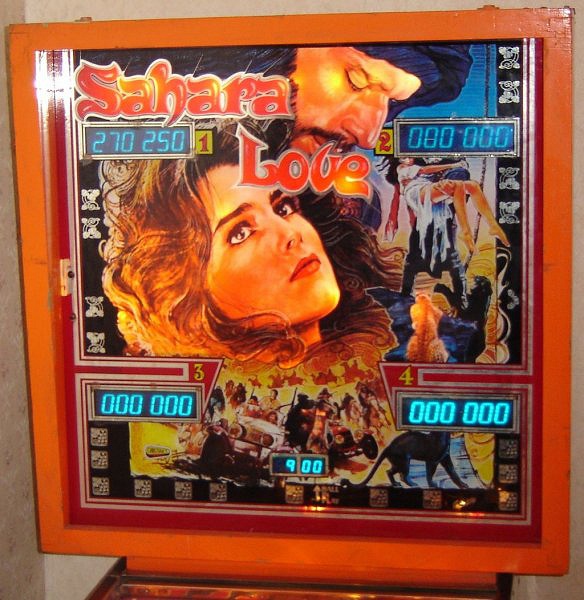
Sahara Love, a rare 1980s solid-state production from K.C. Tabart, stands as one of the most peculiar artifacts in the conversion kit era. With only 150 units confirmed, this machine is a true deep-cut for collectors who appreciate the oddities of international pinball manufacturing. Designed with an adventure-romance aesthetic and featuring cabinet-transforming metal sheets that completely mask the original wood, it is a visual departure from the standard arcade fare of its time. Under the glass, the gameplay relies on a structured, methodical approach to scoring that rewards players who can maintain focus under pressure.
The heart of the experience lies in the drop target banks, which act as the primary gatekeepers for progression. You cannot simply cherry-pick your multipliers; the game demands a hierarchical completion of banks to climb the bonus ladder. Successfully clearing these targets doesn’t just bump your multiplier—it resets the field, inviting you to start the grind all over again. Strategic play revolves around maximizing the spinner and star rollovers to build your bonus toward the 15,000-point ceiling, while keeping an eagle eye on the purple bank. Completing this specific set is the key to lighting the extra ball lane, a high-stakes objective that can define a tournament-level score.
While it lacks the complex multi-ball modes of modern machines, Sahara Love offers a classic, disciplined challenge that feels like a puzzlebox. The integration of the conversion kit elements—specifically the metal plating—gives the machine a distinct, industrial feel that separates it from its peers. For the seasoned player, success here is all about rhythm and target management; if you can navigate the drop targets in the correct order to unlock those elusive extra balls, you’ll find that this obscure piece of history has a surprising amount of bite.