
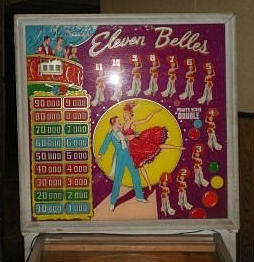
Eleven Belles, Keeney’s distinctive electromechanical offering, stands as a testament to the design ingenuity of Ed Krynski, brought to life by the evocative artwork of George Molentin. Released into an era of burgeoning pinball innovation, this machine captures the glamorous theme of dancing and pageantry, likely conjuring images of a vibrant stage show or a theatrical revue through its illuminated playfield and colorful backglass. Krynski’s vision, combined with Molentin’s artistic flair, created a captivating experience that, while simple by modern standards, demanded a unique brand of player engagement.
What truly sets Eleven Belles apart in the pantheon of classic EMs is its singular gameplay premise: it is a “one ball game.” This isn’t merely a feature; it’s the entire design philosophy. Players receive just one ball per play, transforming every game into a high-stakes, all-or-nothing endeavor. Without the luxury of extra balls or the chaos of multiball, success hinges entirely on precision, control, and maximizing every single shot. The playfield, with its light-based scoring, would have demanded players focus intently on lighting up specific targets or sequences to rack up points within their extremely limited opportunity.
The strategy for Eleven Belles is inherently tied to its one-ball nature. There’s no room for error, no chance to recover from a poorly aimed flip or an unfortunate drain. Players must master the geometry of the playfield, understanding how to nudge, trap, and shoot with absolute confidence to achieve the highest possible score before their solitary sphere inevitably falls. This design choice by Keeney offers a stark contrast to the endurance and multi-stage objectives of later machines, providing a pure, intense, and deeply satisfying challenge for those who appreciate the immediate gratification and high-pressure stakes of early electromechanical pinball.