
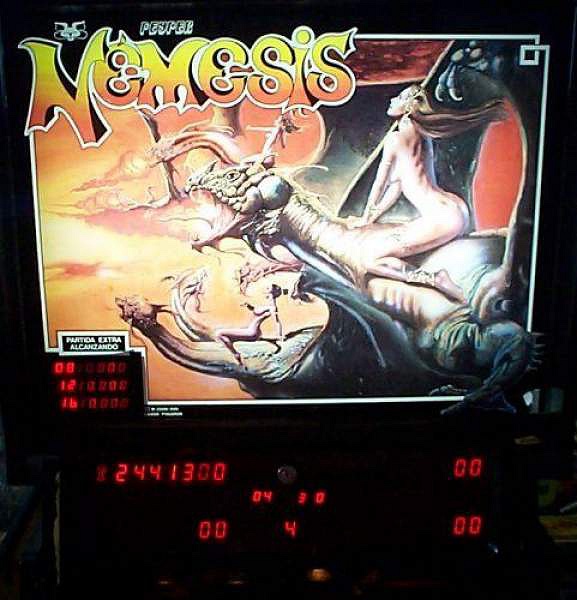
Nemesis, a solid-state release from the Spanish manufacturer Peyper, stands as a curious relic of 1980s fantasy-themed arcade design. Conceived by designer Eulogio Pingarrón, the cabinet leans into the era’s fascination with high-concept, atmospheric visuals, utilizing a traditional alphanumeric display to track the progress of up to four players. While the playfield layout remains a product of its time, it captures that distinct, slightly off-beat charm characteristic of European production machines from the decade, offering a stark alternative to the dominant American manufacturers of the period.
The gameplay is built around a standard three-ball progression that demands precision in an era before deep, rule-heavy code became the industry standard. Without the complex mission-based structures found in modern tables, success on Nemesis relies on mastering the geometry of the playfield and capitalizing on the rhythmic, mechanical feedback of its vintage components. It is a machine that rewards a steady hand and a keen eye for the bounce, serving as a reminder of a time when pinball was defined by raw, tactile interaction rather than cinematic modes or elaborate toy integration.
For the modern collector, Nemesis represents a deep cut in pinball history, offering an analytical look at how international design houses interpreted the fantasy genre. Its simplicity is its primary challenge; with fewer distractions and a focus on the fundamental physics of the ball, it remains a test of fundamental flipper skills. Pingarrón’s work here is a testament to the era’s creative spirit, providing a unique, albeit challenging, experience for anyone looking to step away from the digital complexity of today’s games and return to the roots of the silver ball.