
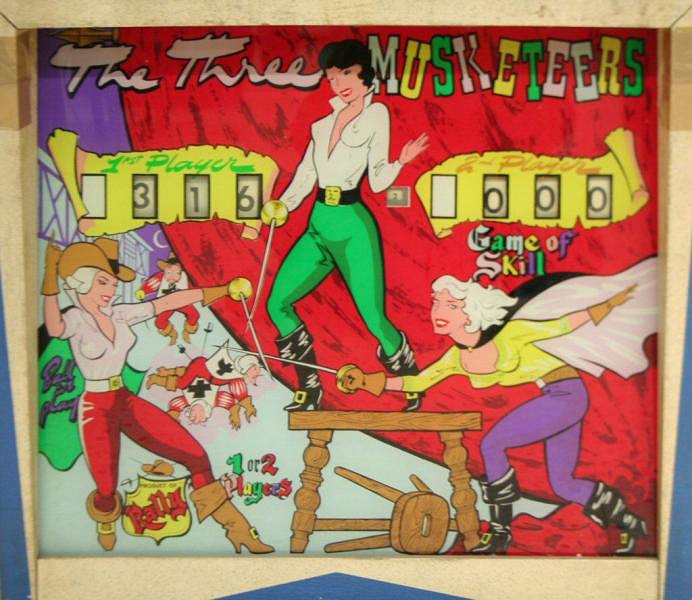
The Three Musketeers, produced by Rally, serves as a classic relic of the electromechanical era, capturing the swashbuckling spirit of Alexandre Dumas’ legendary heroes. As a two-player machine defined by its vintage charm and reliance on traditional score reels, it strips the pinball experience down to its raw, kinetic essentials. This is not a table of deep code or motorized spectacles, but rather a test of steady aim and rhythmic control, utilizing a standard two-flipper configuration to navigate a field punctuated by a trio of pop bumpers.
The playfield layout is focused and uncluttered, favoring a direct, high-stakes approach to the adventure theme. Without the digital complexity of modern cabinets, the game relies entirely on the player’s ability to manage the ball’s momentum through the bumpers to rack up points. For those looking to master this machine, the key lies in understanding the predictable, albeit lively, rebound patterns of the pop bumpers; success here is often found by nudging the cabinet to influence the ball’s path toward the high-value scoring zones rather than relying on sheer force. It remains a quintessential example of mid-century design, where the thrill of the game is found in the satisfying mechanical click of the reels and the timeless pursuit of the high score.