
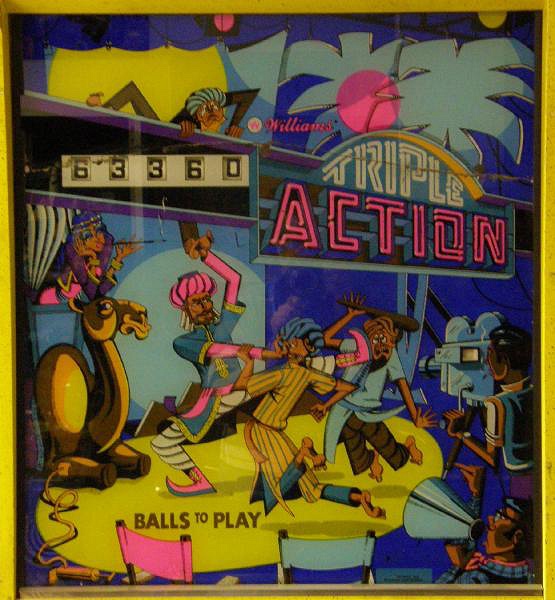
Triple Action, a classic electro-mechanical offering from the Spanish manufacturer Segasa, stands as a charming relic of the late-era EM period. Built with the vibrant, show-business aesthetic common to the era’s arcade staples, the machine relies on a straightforward but demanding playfield layout. Eschewing complex modern gimmicks, the game centers its challenge around a tight quartet of drop targets and a set of spinning posts that act as the primary obstacles for any player looking to rack up a high score on the mechanical reels.
The gameplay loop in Triple Action is deceptively simple, rewarding precision over chaos. While the playfield is populated with the usual suspects—two flippers, three pop bumpers, and a pair of slingshots—the real objective lies in the drop target bank. Savvy players will focus on clearing those four targets twice to claim a lucrative extra ball or a significant 10,000-point bonus. For those looking to optimize their time at the machine, the top rollover lanes are a vital tool, as they effectively “spot” the turntable, bypassing the need to hit the spinning target directly.
Despite its vintage pedigree, the game offers a surprisingly rhythmic experience for those who enjoy the “orbit-heavy” style of play. If you find yourself in a groove, the most consistent path to a high score is to simply hammer the orbits repeatedly. It is a no-nonsense, high-repetition machine that embodies the pure, tactile satisfaction of 1970s pinball, demanding steady aim and a rhythmic touch to keep the ball in motion and the reels spinning.