
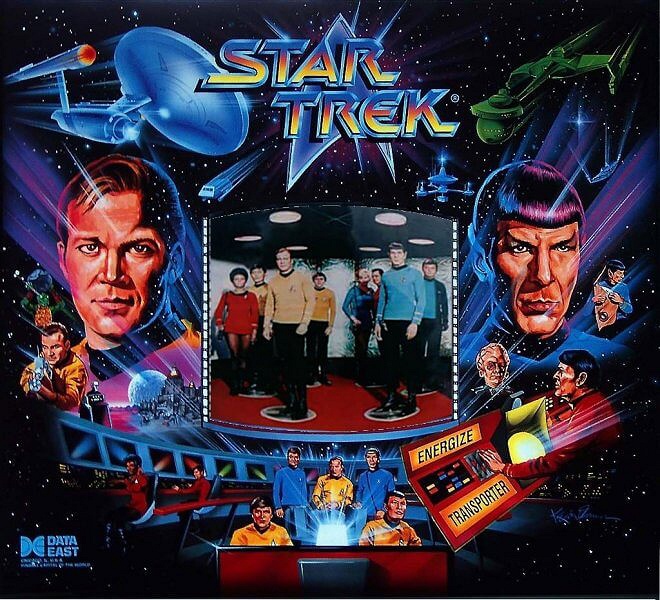
Set your phasers to “millions,” because Data East’s 1991 Star Trek beams the original five-year mission onto a playfield built for galaxy-spanning scoring. The design team of Joe Kaminkow and Ed Cebula gave this one a genuine showpiece: a patented Transporter Effect in the backbox, a clever shimmer of moving semi-transparent layers, plus a mirror at the back of the playfield that lets you spy the top rollover the way later classics would borrow. With a confirmed 4,400 built, it remains one of the more handsome early-DMD licensed games on any floor.
For all its theatrical flourishes, the road to a big score is wonderfully direct. Alternating the two ramps banks millions and keeps you safe, and most competitors will tell you that ramp rhythm is the backbone of a winning game here. Lighting multiball means powering up the warp drive by completing the numbered crystals, with the left scoop spotting a crystal when lit to speed things along. Once you’re into multiball, enjoy the light show, then alternate between the shot under the left ramp and the relight to keep the jackpots flowing. The skill shot is a satisfying bit of timing — blast the ship on the dot display as you plunge — and on certain machines the center shot behind the swinging target becomes a near-unfair engine, lighting other shots and practically giving the game away.
Star Trek captures the optimism of its source: forward motion, teamwork, and the thrill of pushing into the unknown. It’s an accessible, good-looking machine with just enough depth to reward the players who learn its rhythms. Engage the ramps, charge the warp drive, and boldly go.