
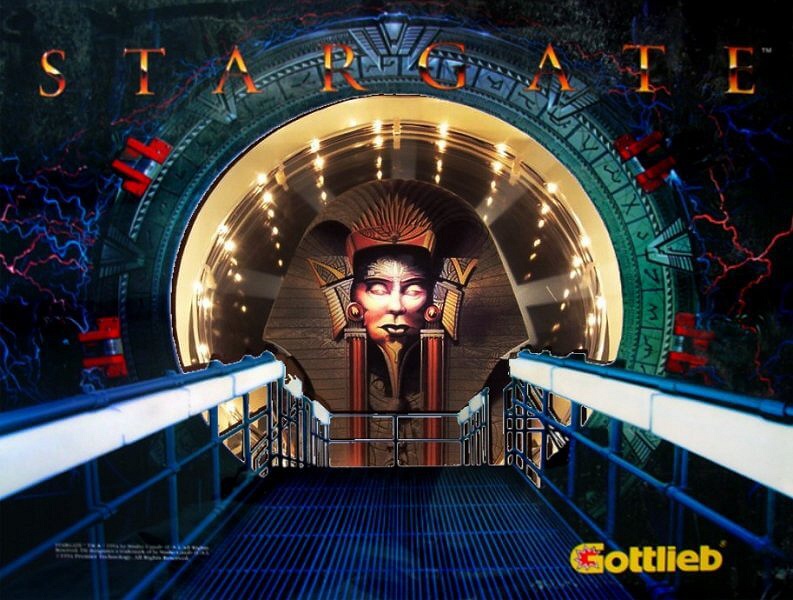
Gottlieb’s 1995 *Stargate* remains a towering achievement of the mid-nineties, capturing the vast, mystical scope of the sci-fi epic through the collaborative design efforts of Ray Tanzer and Jon Norris. At the center of the playfield sits the game’s namesake pyramid, a complex mechanical centerpiece that anchors the machine’s deep integration of myth and high-tech adventure. With a trio of flippers and a frantic, high-stakes rule set, the game demands precision rather than brute force, rewarding players who can navigate its dense array of orbits and drop targets while managing the tension of its unforgiving multiball modes.
The gameplay is defined by a distinct “Battle” mode, which stands as the most lucrative path to a high score; by alternating between the left orbit and the “Trade Quartz” shot, savvy players can extend their time and escalate values indefinitely, provided they keep their cool under pressure. Mastery of the table also requires manipulating the transporter awards found in the left orbit—rather than leaving your fate to chance, you can cycle through these rewards by hitting the left pyramid target, allowing you to strategically hold onto that essential 3x scoring multiplier for a more lucrative mode.
One of the most unique quirks of *Stargate* is its unconventional start-up strategy: a soft, controlled plunge can feed a cross-playfield ramp that triggers the Sarcophagus kickback, and if timed correctly on your first ball, it can launch you straight into multiball. Be warned, however, that this is a high-risk environment; the initial two-ball multiball lacks a safety net, making that first successful jackpot—which upgrades the chaos into a three-ball frenzy—an absolute necessity for survival. It is a dense, rewarding experience that demands total focus, standing as a quintessential example of Gottlieb’s late-era ambition.