
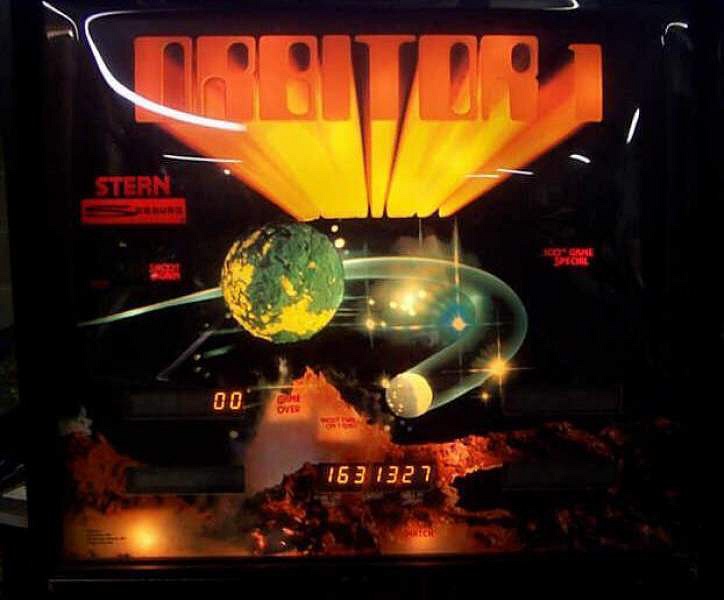
Orbitor 1, released by Stern Electronics in 1982, remains one of the most polarizing and visually distinct machines in pinball history. Designed by Joe Joos Jr. with a concept birthed by Dixie Rinehart and Art Myers, this widebody oddity ditched the traditional flat playfield for a literal three-dimensional, lunar-crater landscape. Its space-age aesthetic is driven by a unique, undulating surface that forces the ball to behave with a gravity-defying unpredictability, turning standard trajectory calculations into an exercise in pure chaos.
The mechanical heart of this machine is as unconventional as its topography. Instead of standard pop bumpers, Orbitor 1 utilizes spinning bumpers that agitate the ball as it traverses the uneven, cratered terrain. With a seven-bank drop target array and two additional three-bank sets, the game offers plenty of targets to aim for, though hitting them requires compensating for the dramatic rolls and unexpected hops caused by the playfield’s convex design. A single kick-out hole and a dedicated spinning target round out the experience, punctuated by the era-appropriate digitized speech that reinforces the deep-space atmosphere.
Mastering Orbitor 1 is less about refined ball control and more about learning the erratic “geography” of the machine. Because the ball rarely tracks straight, players should focus on high-percentage shots toward the drop target banks to build scoring multipliers before the ball inevitably finds a crater and drains. It is a rare collector’s piece—with fewer than 900 units produced—that serves as a fascinating, if frustrating, experiment in game design. While it may not offer the precision of modern Stern titles, Orbitor 1 stands as an essential chapter in the history of arcade experimentation, proving that sometimes, designers were willing to throw the rulebook into orbit just to see what would happen.