
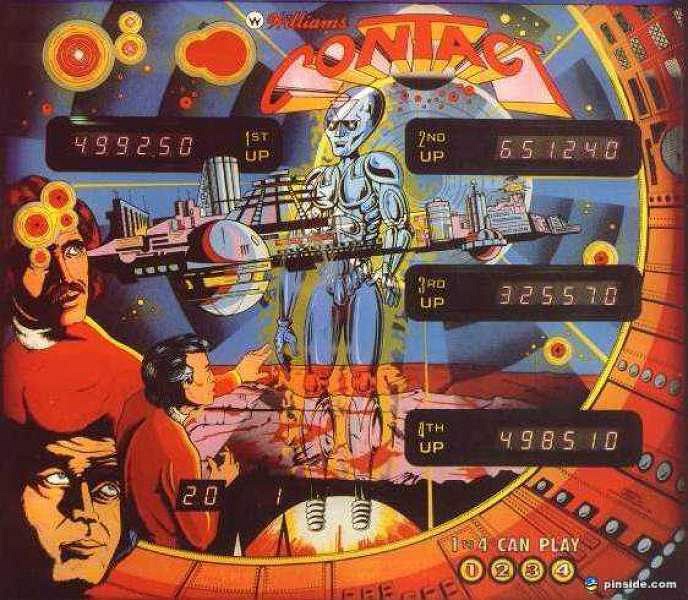
Contact, the 1978 widebody masterpiece from Williams, stands as a quintessential artifact of the late-seventies era when designers like Steve Kordek were pushing the boundaries of playfield real estate. With its sprawling, expansive layout, the machine leans heavily into a retro-futuristic alien aesthetic brought to life by the distinct, high-contrast art of Christian Marche. This widebody design is more than just a novelty; it forces the player to manage a vast expanse of territory, utilizing an unconventional four-flipper setup—including a pair of lower flippers and an additional set higher up the field—to navigate the complex geometry of the horseshoe lane and the central four-bank of drop targets.
The mechanical heart of the game revolves around precision shot-making into the dual kick-out holes and the swinging target, which demands rhythmic timing to maximize scoring. One of the defining features of this era is the up-post positioned directly between the lower flippers; a seasoned player knows this is the ultimate safety net, capable of saving a ball from an untimely drain if tapped at the precise moment. Unlike modern machines that rely on complex software modes, Contact is a pure test of control and spatial awareness. Navigating the wide playfield requires a calculated approach, as the ball trajectory across such a large surface creates long, sweeping sightlines that differ significantly from the tighter, faster corridors found on standard-width tables.
Produced in a limited run of just over 2,500 units, Contact remains a highly sought-after specimen for collectors who appreciate Kordek’s functional, no-nonsense design philosophy. While it lacks the flashy digital displays of the modern era, the game’s reliance on tactile feedback—the satisfying snap of the drop targets and the rhythmic clatter of the horseshoe orbit—captures the raw essence of space-age pinball. It is a slow-burn strategy game that rewards players who can master the wide-angle shots and effectively utilize the up-post to extend their playtime under the watchful, extraterrestrial gaze of Marche’s iconic cabinet art.