
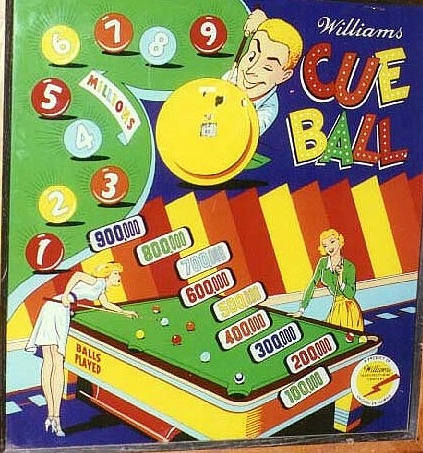
Cue Ball, released by Williams in 1957, stands as a quintessential relic of the late-fifties era, showcasing the minimalist charm of designer Harry Williams. With art by the legendary George Molentin, the machine leans heavily into its billiards theme, trading the complex ramps and magnets of modern manufacturing for the raw, tactile satisfaction of an electromechanical layout. It is a game defined by its simplicity and the classic geometry of the pool hall, demanding precision rather than flow.
The playfield is sparse but strategic, anchored by a pair of flippers and four distinct pop bumpers that keep the action chaotic and unpredictable. The defining mechanical challenge of Cue Ball is the presence of four gobble holes, which act as both a scoring objective and a high-risk hazard. Navigating the ball past the six standup targets and into these pockets requires a steady hand and a keen eye for angles, as the game rewards players who can master the rebound off the slingshots to set up a clean shot into the scoring zones.
For those looking to conquer this vintage classic, the strategy is entirely about board management. Because the gobble holes are your primary point-generators, you must avoid the temptation of aggressive, blind flipping. Instead, focus on trapping the ball and using the flippers to “bank” your shots off the playfield rubbers, mimicking the movement of a real cue ball on a felt table. It is a stripped-back, high-stakes test of control that proves you don’t need a digital display to feel the tension of a perfect break.