
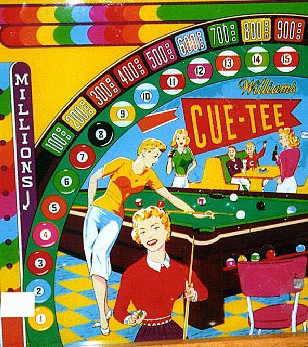
Cue-Tee, released by Williams in 1946, stands as a quintessential relic of the early electro-mechanical era, bearing the distinct creative thumbprint of design legend Harry Williams. Eschewing the complex multi-ball chaos of modern machines, this single-player title leans into a classic billiards theme, brought to life through the austere and charming hand-drawn aesthetics of artist George Molentin. The playfield is a study in minimalist geometry, utilizing a pair of flippers to navigate a layout defined by two active pop bumpers, three passive bumpers, and a pair of strategically placed gobble holes that demand precision over raw speed.
The mechanical simplicity of the game belies the challenge inherent in its design. Because the playfield lacks the dense target arrays of later decades, success on Cue-Tee relies on mastering the rebound angles provided by the passive bumpers and calculating the precise trajectory needed to avoid the dreaded gobble holes. It is a game of finesse, where the player must treat the ball like a cue ball on a felt table, carefully banking shots to rack up points across the sparse but punishing landscape.
For those looking to conquer this vintage gem, the primary strategy involves controlling the ball’s momentum off the slingshots to avoid the sinkholes entirely. While it lacks the digital flash of contemporary pins, Cue-Tee offers a tactile, rhythmic experience that highlights the foundational mechanics of the sport. It remains a fascinating piece of arcade history, serving as a reminder of a time when a well-placed shot and a steady hand were the only things standing between a high score and an abrupt end to your ball.