
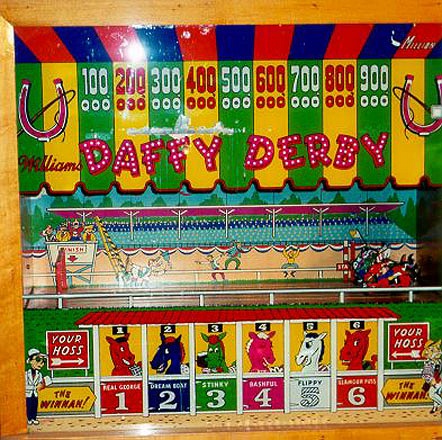
Daffy Derby, the 1947 classic from Williams, stands as a quintessential relic of the early post-war era, showcasing the foundational genius of designer Harry Williams. As a single-flipper EM machine, it strips the pinball experience down to its barest, most frantic essentials, trading modern complexity for the charm of a day at the races. George Molentin’s artwork brings the horse-racing theme to life, but the real star is the mechanical backbox animation, which tracks the progress of the ponies as you navigate the playfield’s modest but treacherous geography.
The mechanical layout is deceptively simple, anchored by a solitary flipper that demands precision rather than brute force. Players must navigate a dense forest of four active pop bumpers and a single passive bumper, aiming to drop the ball into one of the three trap holes that serve as the primary scoring gateways. The inclusion of two captive balls adds a layer of tactical resistance, forcing the player to manipulate the playfield geometry to trigger the high-scoring sequences. In this vintage setup, the game isn’t about deep rulesets or massive modes; it’s about controlling the rebound and mastering the timing of the lone flipper to keep the ball in play long enough to cross the finish line.