
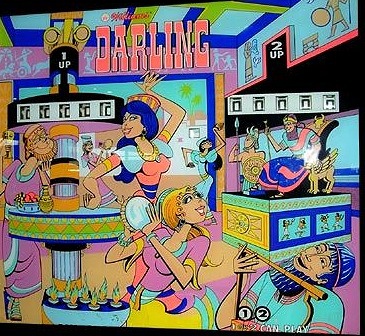
Williams’ 1972 release *Darling* stands as a quintessential piece of the Steve Kordek era, blending classic electromechanical charm with the distinctively stylized, high-contrast artwork of Christian Marche. As a two-player machine, it captures the straightforward, competitive spirit of the early seventies, favoring precise nudging and ball control over the complex rule-sets of the modern era. The playfield is defined by its mid-century aesthetic, utilizing a sparse yet effective layout that forces players to navigate around a cluster of five captive balls, which serve as the primary hurdle for racking up significant point totals.
Mechanically, the game relies on a pair of pop bumpers and a strategic arrangement of rollover buttons and ball kickers to keep the play fast and unpredictable. The inclusion of a rollunder adds a touch of tactical depth, requiring players to master their timing to navigate the ball safely back into play. With a production run of nearly 3,700 units, *Darling* became a familiar fixture in arcades of the time, celebrated for its reliability and the satisfying, rhythmic “thwack” of its reel-based scoring system.
For those looking to master this classic, success hinges on managing the captive balls effectively; rather than simply bashing them at random, seasoned players aim to manipulate the ball’s trajectory to trigger the kickers consistently. By prioritizing the rollover sequences, you can maximize your scoring potential before the ball inevitably finds the outlanes. It is a lean, honest machine that highlights why Kordek’s designs remain the bedrock of the hobby—it’s not about how many toys you can cram onto the deck, but how well you can make a player sweat over a single, well-placed shot.