
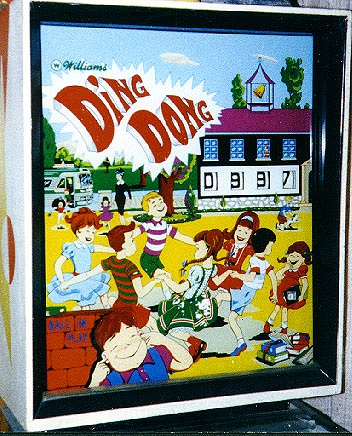
Ding Dong, released by Williams in 1968, stands as a quintessential artifact of the late-sixties electro-mechanical era. Designed by the legendary Norm Clark with the whimsical, high-energy aesthetic of artist Christian Marche, the machine leans into a lighthearted school-day theme that captures the uncomplicated joy of classic pinball. It is a single-player, reel-based delight that focuses on the purity of the game rather than the complex rule sets of the modern era, offering a brisk, tactile experience that rewards precise aim and rhythmic flow.
The gameplay is defined by the era’s hallmark simplicity, where the goal is to navigate the playfield’s geometry to rack up points on the mechanical reels. While it lacks the digital complexity of today’s machines, its charm lies in the satisfying feedback of its electromechanical relays and the vibrant, nostalgic artwork that Marche brought to life. With a production run of just under two thousand units, it remains a sought-after piece for collectors who appreciate the “golden age” of Williams design.
Strategy on a machine as straightforward as Ding Dong is less about complex mode management and more about maintaining focus and ball control. The golden rule for this table is simple: avoid careless mistakes. Because the machine lacks the safety nets and multiball chaos of contemporary titles, every shot counts, and the player’s ability to predict the ball’s movement off the bumpers and slingshots is paramount. It’s an honest, no-nonsense test of skill that serves as a perfect palate cleanser for any serious pinball enthusiast.