
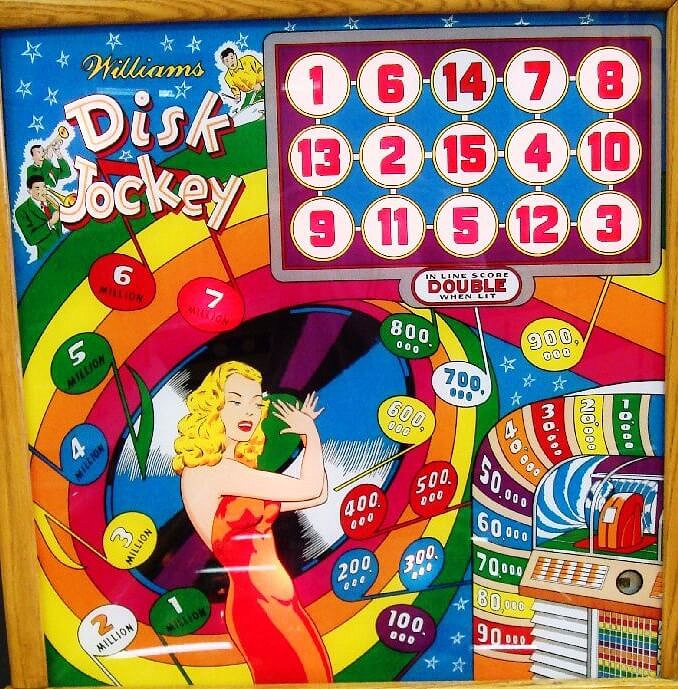
Disk Jockey, released by Williams in 1952, stands as a quintessential relic of the early post-war era, capturing the infectious energy of the dance hall through the visionary lens of designer Harry Williams. With artwork by George Molentin, the machine eschews the complex mechanical toys of the modern era, opting instead for a hypnotic, minimalist aesthetic that focuses purely on rhythm and precision. The playfield is a dense grid of fifteen trap holes, creating a high-stakes environment where the ball is constantly at risk of being swallowed by the board, forcing players to develop a delicate, rhythmic touch to keep the action alive.
The layout is a fascinating study in mid-century design, utilizing a solitary pop bumper to inject chaotic movement into the playfield, while seven passive bumpers act as bumpers and blockers that dictate the flow of the ball toward the scoring zones. Unlike the power-heavy pins of later decades, Disk Jockey relies on its pair of impulse flippers to navigate a crowded field of targets. The challenge here is less about hitting ramps and more about managing the geometry of the board; success requires the player to treat the flippers like a record player’s needle, carefully tracking the ball’s path to avoid the trap holes while aiming for the highest point-accruing pockets. It is a deceptively simple, challenging experience that highlights the elegance of early electro-mechanical engineering.