
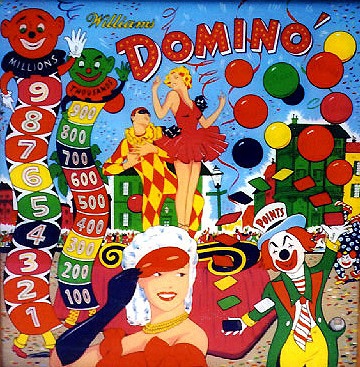
Domino, released by Williams in 1968, serves as a charming time capsule of the late-sixties electro-mechanical era. Engineered by the legendary Harry Mabs with vibrant, rhythmic cabinet art by George Molentin, the machine leans into a carnival-inspired aesthetic that celebrates music and dance. While it lacks the high-octane mechanical complexity of the modern era, Domino relies on the satisfying, tactile geometry that defined Mabs’ career, utilizing a classic two-flipper layout to navigate a playfield punctuated by three pop bumpers and a trio of strategically placed kick-out holes.
The gameplay experience is built around precision and anticipation, challenging the player to master the flow between the bumpers and the kick-out zones. Because the machine utilizes light-based scoring rather than digital displays, the focus remains entirely on the physical movement of the ball across the playfield. Success on Domino requires a steady hand and a rhythmic approach to nudging, as the kick-out holes act as both scoring targets and potential traps. It is a quintessential example of mid-century design, offering a pure, unadulterated pinball experience that prioritizes mechanical feedback and high-stakes accuracy over the flashy gimmicks of later decades.