
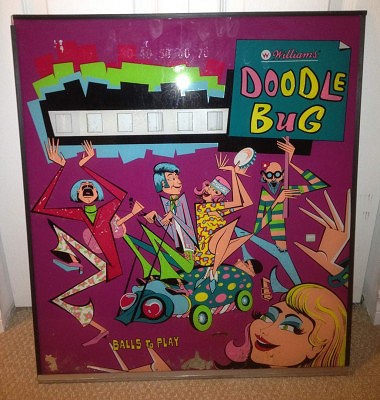
Williams’ Doodle Bug, released in 1971, is an inventive early-70s electromechanical whose signature feature lives below the playfield. A captive ball — the “Doodle Bug” — runs back and forth across a point-scoring rollover in a hidden mechanism, racking up points continuously once you set it in motion, a genuinely novel bit of mechanical theater for its day wrapped in a cheerful music-and-dancing theme.
The whole game orbits that gizmo. Shooting the center standup starts the Doodle Bug scoring, which keeps ticking until you drain or hit “Stop Doodle Bug,” and hitting the lit standup targets cranks the captive ball’s value up the ladder from 10 to 100 to 1,000 to a hefty 10,000 points. Completing the 1-through-4 targets boosts the scoring further, and the far-right red eject-hole award of 5,000 points can flat-out win games. There’s even a strategic debate baked in: depending on the settings, constantly stopping and restarting the Doodle Bug can sometimes out-earn letting it run. A quirky design note keeps you honest — a gap between the flipper and slingshot means you can’t cradle the normal way, so when a ball’s heading for the hole, you simply mash the flipper.
Clever, interactive, and full of personality, Doodle Bug is a standout of early-70s Williams design. For collectors who love a one-of-a-kind mechanical hook, it’s a fascinating and genuinely fun classic.