
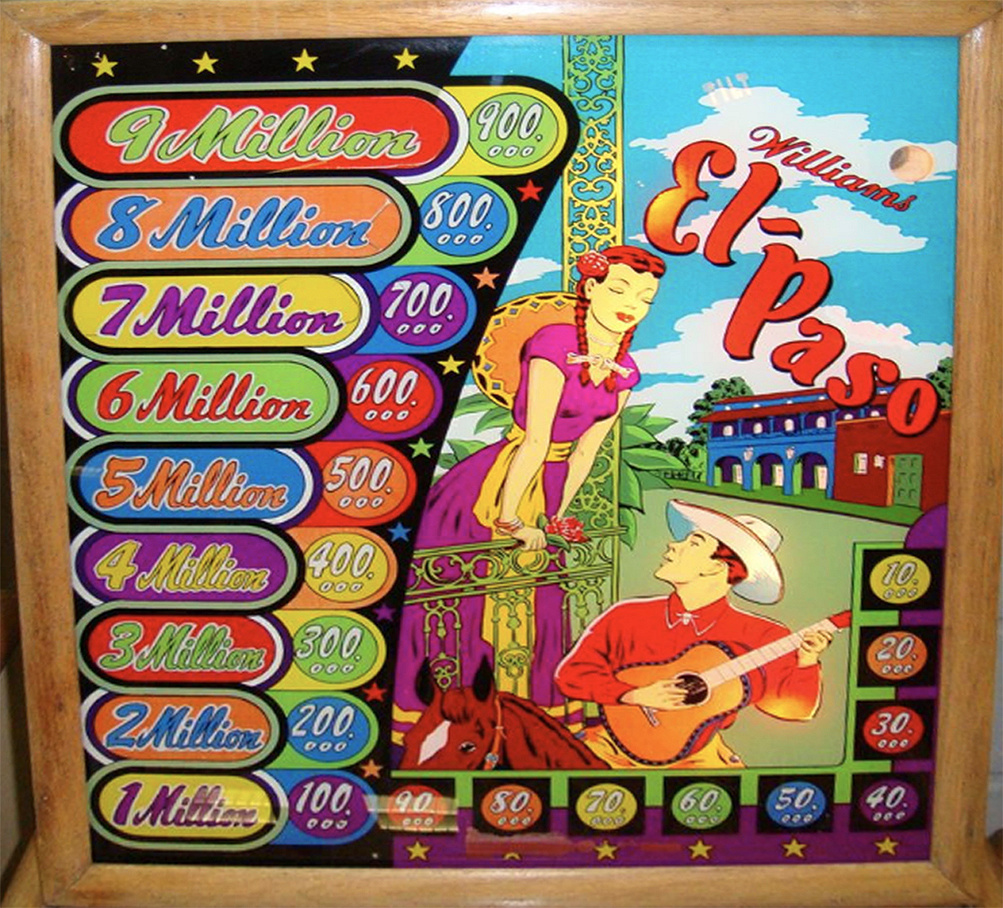
El Paso, released by Williams in 1948, stands as a quintessential artifact from the golden age of electromechanical design. Masterminded by the legendary Harry Williams and featuring the distinct aesthetic sensibilities of artist George Molentin, this single-player machine strips pinball down to its most fundamental, rhythmic core. Eschewing the complex multi-level toys of the modern era, El Paso leans into the simplicity of its “American Places” theme, offering a focused experience that demands precision over spectacle.
The machine operates with a stark, no-nonsense efficiency that defined the late 1940s arcade scene. With a standard five-ball play cycle priced at a nickel, the game provides a compelling test of nudge-based control and kinetic timing. Without the crutch of modern flippers or high-tech magnets, success here relies entirely on mastering the playfield’s geometry and the unpredictable nature of the ball as it navigates the lit targets. It is a masterclass in minimalism, proving that even seven decades later, the mechanical heartbeat of a well-calibrated EM machine remains a challenge for any serious collector.