
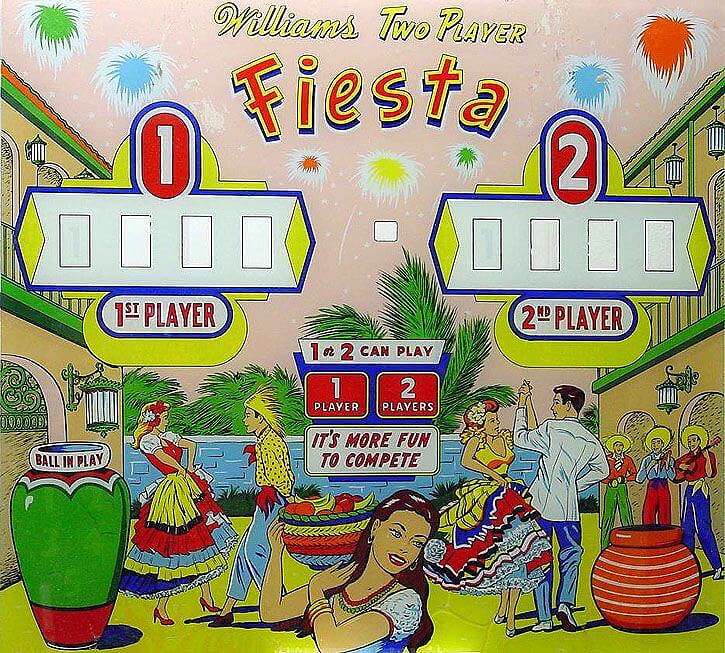
Fiesta, a vibrant 1948 release from Williams, stands as a quintessential artifact of the early electromechanical era. Designed by the legendary Harry Mabs with festive, colorful art provided by George Molentin, the game captures the high-energy spirit of a mid-century celebration. Unlike the high-speed ramps and magnets that would define the industry decades later, Fiesta relies on a classic, symmetrical playfield layout that demands precision and patience. With four flippers at the player’s disposal, the challenge lies in navigating the board’s mid-century architecture, which features a mix of active pop bumpers and strategic passive bumpers designed to keep the ball in constant, unpredictable motion.
The playfield layout is defined by its old-school charm, utilizing three standup targets and a pair of traditional gobble holes that act as both scoring opportunities and potential hazards. One of the machine’s most intriguing design choices is the integration of a score drum directly into the playfield, a clever visual touch that keeps the player’s focus on the action rather than the backglass reels. Because the game lacks the deep rulesets of modern machines, the strategy here is purely rhythmic—mastering the timing of the flippers to bounce the ball between the slingshots and bumpers is essential for racking up a high score on the drum.
For the vintage enthusiast, Fiesta represents a foundational moment in pinball history. Mabs’ design is deceptively simple, yet it rewards players who can control the ball’s momentum in an environment where every bounce is magnified by the lack of modern ball-saving features. It is a loud, tactile experience that eschews complex digital modes for the pure, unadulterated thrill of the rebound. Whether you are a collector or a student of the game’s evolution, Fiesta remains a lively reminder of a time when pinball was about the raw, mechanical connection between the player and the ball.