
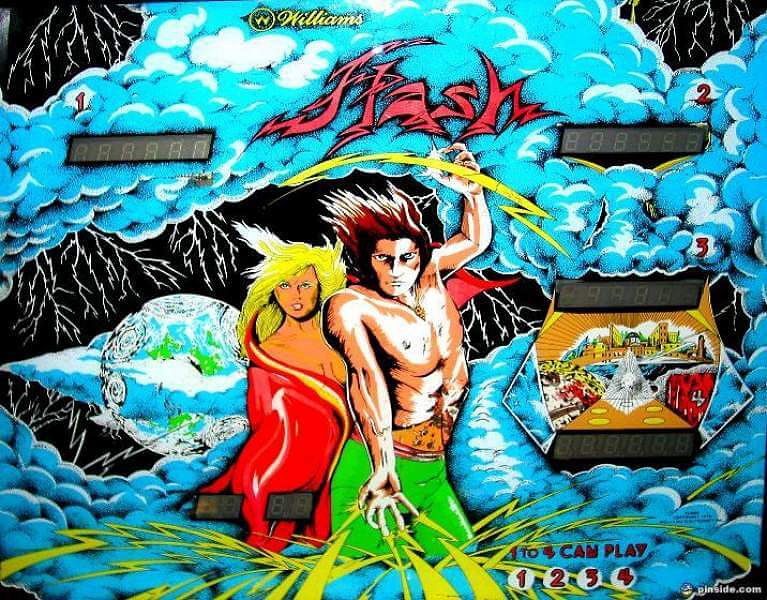
A blinding bolt of pinball history — Williams’ 1979 Flash is a landmark machine, famous as the first pinball game to outsell its production expectations so dramatically that it helped define the solid-state boom, with a colossal confirmed run of 19,505. Designed by a young Steve Ritchie, who would go on to become one of pinball’s most legendary designers, it features flash lamps under the playfield (a then-novel effect that gave the game its name) and a fast, target-rich layout that still plays brilliantly.
The strategy is a clean, spinner-focused climb. Completing the drop targets on the left lights the spinner, and the upper loop is a repeatable shot that becomes extremely valuable with that spinner lit — so the engine of a strong game is lighting the spinner and then looping it relentlessly. Consider a soft plunge to get a head start on dropping the five-bank, and since there’s no lane change, nudge for the “4” rollover whenever possible, as completing 1-2-3 gives two-times and 1-2-3-4 gives three-times. The five-bank can be backhanded for a very safe return feed, and once your first five-bank is down, you can backhand the lit right saucer repeatedly for ten thousand a shot — a tidy, low-risk points routine.
Flash is a genuine cornerstone of the medium, the breakout hit that announced Steve Ritchie’s arrival and helped cement solid-state pinball’s commercial future. Those under-playfield flash lamps were a sensation in 1979, and the spinner-and-loop scoring remains deeply satisfying. Light that spinner, ride the upper loop, build your multiplier, and pay tribute to one of the most important and best-selling machines ever made. History rarely plays this good — and Flash absolutely does.