
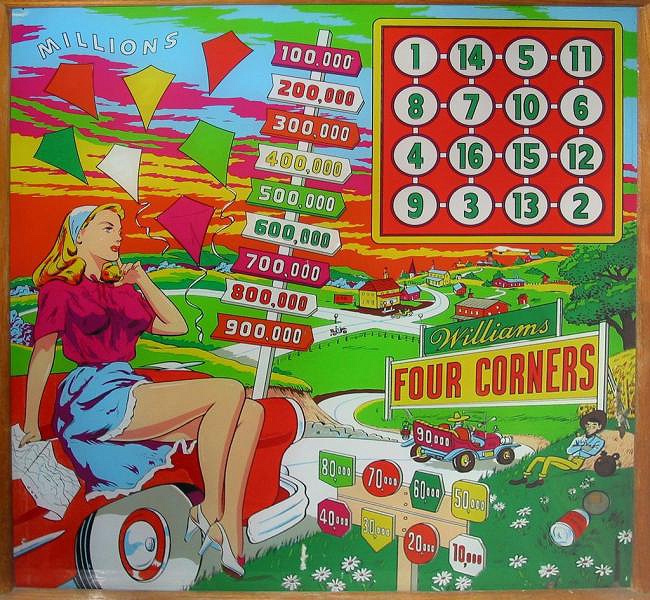
Four Corners, released by Williams in 1952, serves as a quintessential artifact of the early post-war era, capturing the spirit of American travel and automobile culture. Designed by the legendary Harry Williams and featuring the distinctive, clean-lined aesthetic of artist George Molentin, this single-player electromechanical machine eschews the complex playfield gimmicks of later decades in favor of pure, focused skill. It is a time capsule of an era where the thrill of the game was measured by a nickel’s worth of play and the rhythmic mechanical clicking of a scoring relay.
The machine’s layout is a study in minimalist design, reflecting the straightforward, high-stakes nature of early fifties pinball. With no digital displays or complex mission modes to navigate, the player’s objective is purely tactile—mastering the physics of the playfield to rack up points across the “four corners” of the board. In an age before multi-ball chaos or deep rule sets, success here relied on a steady hand and an intuitive understanding of the ball’s trajectory as it navigated the bumpers and lanes.
While modern players might find its lack of flashy toys jarring, Four Corners offers a refreshing, meditative experience for the purist. It stands as a testament to Harry Williams’ ability to craft an engaging experience using nothing more than gravity, steel, and a handful of strategically placed obstacles. For those looking to understand the bedrock upon which the modern arcade was built, this machine remains a vital, historical lesson in how much fun could be squeezed out of five simple balls for a single nickel.