
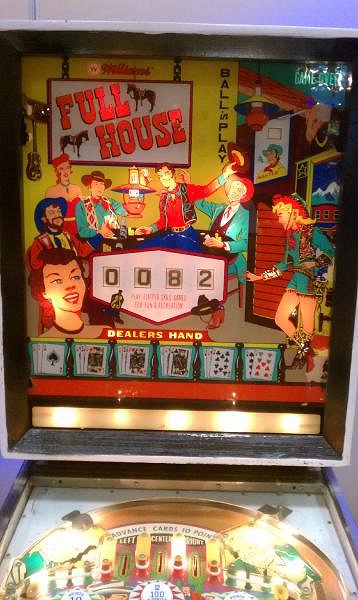
Full House, released by Williams in 1970, stands as a quintessential example of Norm Clark’s mastery of the classic electromechanical era. Evoking the grit and high stakes of the American West, this single-player machine leans heavily into the gambling aesthetic, trading the standard pinball tropes for a poker-inspired playfield. With only 2,900 units produced, it remains a sought-after relic for collectors who appreciate the tactile satisfaction of reel-based scoring and the rhythmic clatter of a true EM machine.
The playfield layout is deceptively straightforward, centering on a collection of seven standup targets that serve as the primary engine for the game’s unique hook: a three-reel drum unit embedded directly into the board. As you navigate the two flippers, three pop bumpers, and two slingshots, the objective is to manipulate these mechanical reels to form a winning poker hand. Unlike the complex mission-based rules of modern digital tables, Full House demands precision shooting to “spin” your way to a high score, rewarding the player with the satisfying mechanical clicks that defined the golden age of Williams arcade engineering.
Mastering this machine requires a focus on target consistency rather than flashy ramp shots. Because the game utilizes a single-player format and relies on the drum unit to track your progress, strategic play revolves around managing the standup targets to cycle the reels toward your desired hand. It is a game of patience and rhythm, where the tension of chasing a “Full House” on the playfield reels mirrors the atmosphere of a saloon poker game. For the purist, this machine is a masterclass in how limited mechanical assets can create a deeply engaging, thematic experience.