
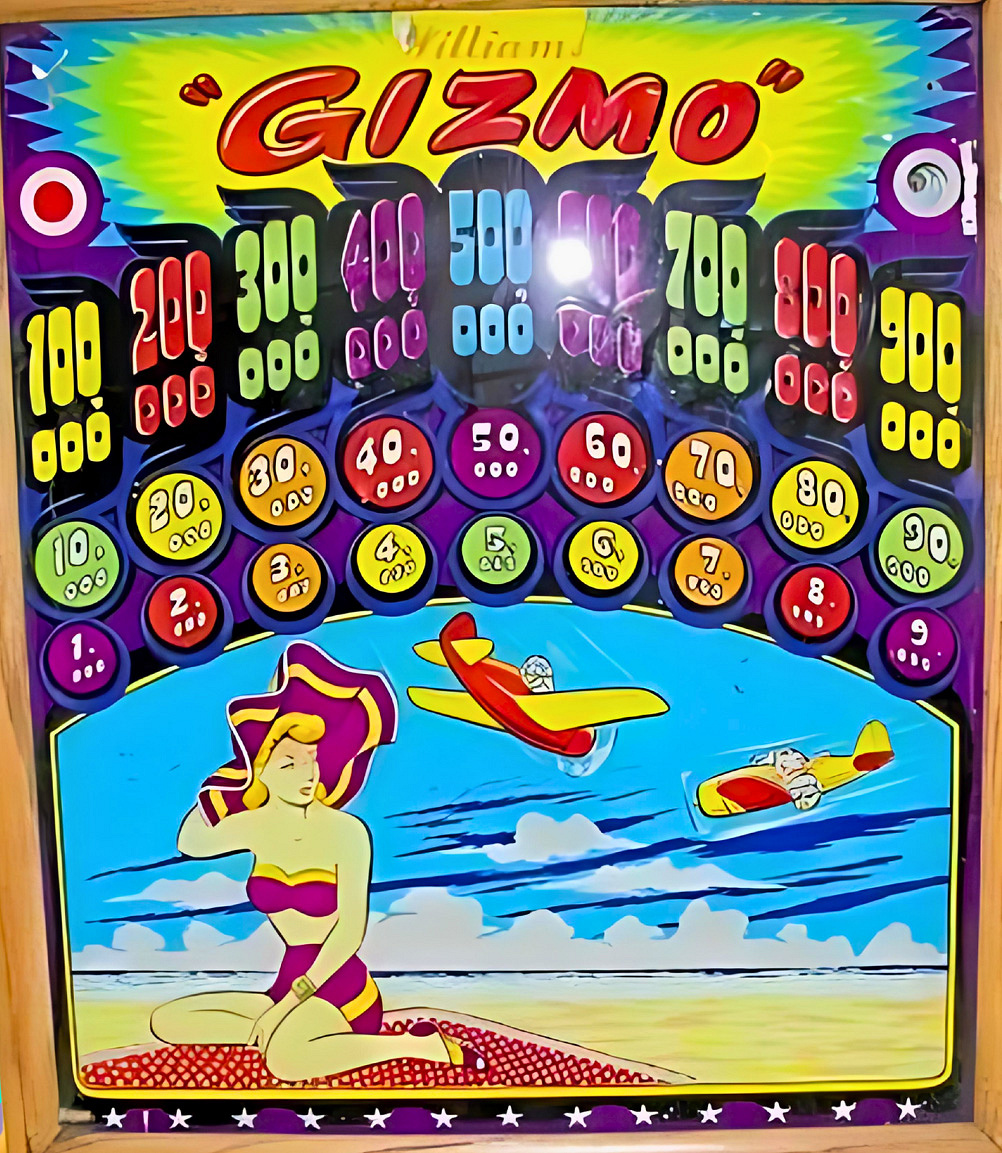
Gizmo, the 1948 aviation-themed classic from Williams, stands as a fascinating relic of the industry’s formative years, born from the combined vision of legends Harry Williams and Sam Stern. Featuring artwork by the iconic George Molentin, this single-player electromechanical machine captures the adventurous spirit of mid-century flight without the digital clutter of modern cabinets. It is a dense, rhythmic experience defined by its sprawling playfield, which eschews complex ramps and toys in favor of a frantic, high-traffic layout designed to test a player’s raw instincts.
The mechanical architecture of Gizmo is remarkably aggressive for its era, boasting a quartet of flippers that demand precision to navigate the nine passive bumpers scattered across the field. The board is anchored by five strategically placed kick-out holes, which act as the primary engines for scoring and ball control. Because the game relies on these pockets rather than modern magnets or motorized toys, success requires a rhythmic “catch and release” style of play. Mastering the angles of the kick-outs is the ultimate test; knowing exactly how the ball will exit these holes is the difference between a high-score run and a quick drain down the outlanes.
While it lacks the flashing LEDs or deep rule sets of contemporary pins, Gizmo’s charm lies in its pure, tactile simplicity. It is an endurance test of board management, requiring the player to constantly track the ball’s trajectory amidst a sea of passive bumpers that can send the game into chaotic, unpredictable directions at a moment’s notice. For the collector or the purist, Gizmo serves as a vital history lesson in early game design, proving that even with basic mechanical components, Williams could create a challenging, high-stakes flight path that feels just as rewarding today as it did decades ago.