
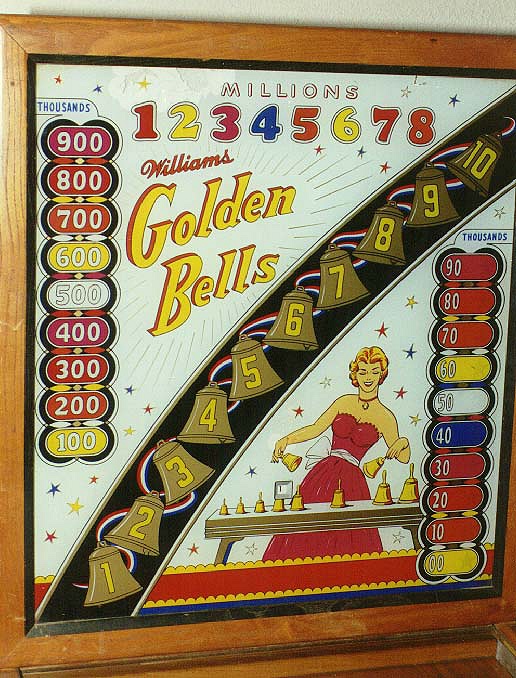
Golden Bells, released by Williams in 1948, stands as a quintessential artifact of the early post-war era, showcasing the foundational design philosophy of Harry Williams. As an electromechanical machine, it eschews modern digital flair for a pure, tactile experience that relies on rhythm and precision. George Molentin’s artwork captures the exuberant, lighthearted theme of the day, transforming the playfield into a vibrant stage where the primary objective is to chase down those elusive bells through a tight, classic layout that demands respect from any serious collector.
The mechanical architecture is deceptively straightforward, anchored by two flippers that must navigate a gauntlet of three active pop bumpers and two passive bumpers. The playfield is peppered with six standup targets and two strategically placed kick-out holes, all designed to funnel the ball toward the machine’s namesake feature: the gobble hole. Unlike the high-speed ramps of modern machines, Golden Bells rewards the player for mastering the subtle geometry of the slingshots and predicting the erratic bounces off the passive bumpers, a skill set that defined the high-score chasers of the late 1940s.
For those looking to conquer this vintage gem, success hinges on controlling the ball’s transition through the lower playfield to avoid the dreaded “drain” scenarios inherent in the era’s open-bottom design. Because the scoring is entirely reliant on the clever use of the kick-out holes to reset or multiply your progress, keeping the ball in play requires a delicate touch rather than brute force. Golden Bells remains a masterclass in minimalist design, proving that even a single-player table can provide a deep, competitive challenge for anyone willing to step back in time to the dawn of the flipper age.