
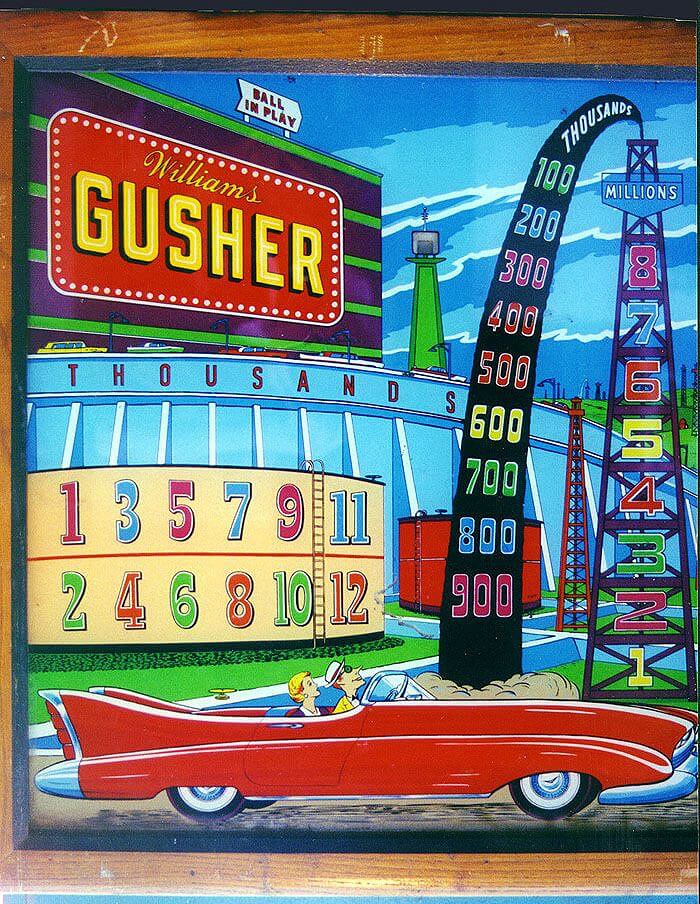
Gusher, the 1958 classic from Williams, stands as a quintessential artifact of the late fifties era, masterfully blending the high-stakes allure of the oil boom with the sleek aesthetic of mid-century automotive luxury. Designed by industry titan Harry Williams with striking, bold artwork from George Molentin, the machine captures the golden age of American industry. It is a single-player mechanical marvel that rewards precision over chaos, utilizing a classic two-flipper layout to navigate a playfield teeming with vintage mechanical obstacles.
The board is a dense, challenging landscape dominated by eight standup targets that demand a steady hand, flanked by the rhythmic thumping of three pop bumpers and four passive bumpers. The inclusion of three distinct kick-out holes provides essential ball relief, though the true centerpiece—and the source of the game’s namesake tension—is the dreaded gobble hole. Unlike modern machines that prioritize deep rulesets, Gusher focuses on the fundamental thrill of the era: managing the ball’s momentum through slingshots and holes while hunting for the high-scoring sequences that signify a successful strike.
For those stepping up to the machine today, the strategy is simple but punishing: master the kick-out hole timing to keep the ball in play and avoid the gobble hole at all costs. Because the machine lacks the safety nets of modern multi-ball modes or digital tutorials, success relies entirely on your ability to read the rebound angles off the passive bumpers. It is a stark, elegant, and unforgiving test of skill that serves as a perfect time capsule for collectors who appreciate the raw, tactile feedback of a well-maintained Williams EM.