
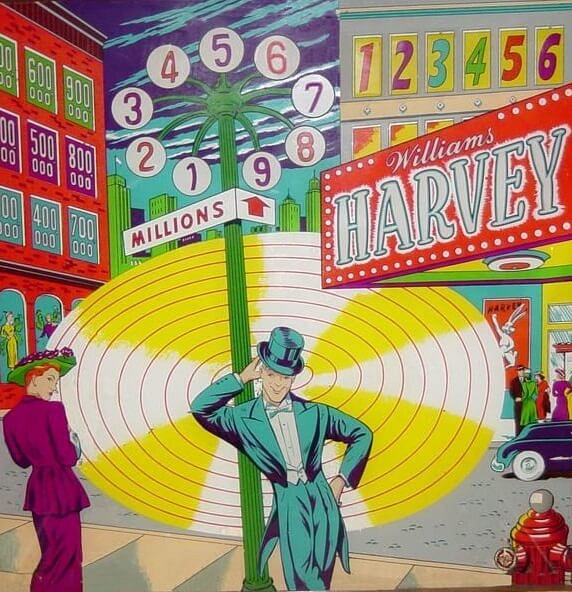
Harvey, a 1950s classic from Williams, stands as a quintessential relic of the early electro-mechanical era. Designed by the legendary Harry Williams himself, with striking cabinet and playfield aesthetics provided by George Molentin, this single-player machine is a masterclass in minimalist design. It eschews the complex multi-level playfields of the modern age in favor of a clean, skill-based layout that demands precision over spectacle, perfectly capturing the mid-century arcade experience.
The mechanical heart of the machine relies on the classic responsiveness of two impulse flippers, tasking the player with navigating a field populated by two active pop bumpers and five passive bumpers. The playfield is punctuated by four strategically placed kick-out holes, which serve as the primary scoring engines of the game. Because the machine lacks the digital complexity of contemporary pins, success in Harvey is entirely dependent on mastering the geometry of the playfield and managing the ball’s trajectory as it ricochets through the bumper clusters.
For the vintage enthusiast, Harvey is a testament to the “less is more” philosophy that defined the golden age of Williams manufacturing. Without the distraction of ramp shots or intricate modes, the gameplay loop is stripped down to its purest form: timing your flipper activation to catch the ball as it exits a kick-out hole or maneuvers through the dense forest of passive bumpers. It is a deceptively simple challenge that rewards patience and a steady hand, proving that even a design from the infancy of the hobby can still command a focused, high-stakes session.