
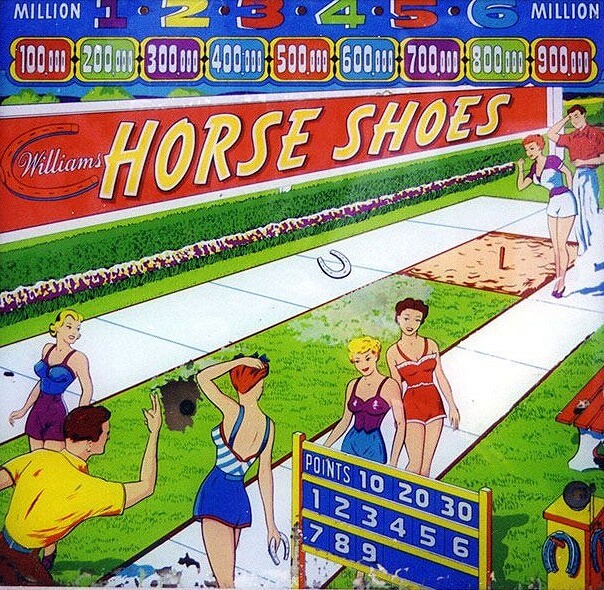
Horseshoes, released by Williams in 1959, stands as a quintessential piece of mid-century Americana, capturing the simple, rhythmic joy of a backyard lawn game within the confines of a classic EM cabinet. Designed by the legendary Harry Williams and featuring the distinctive, clean-lined artwork of George Molentin, this single-player machine strips away the complex rule sets of the modern era in favor of a tactile, pure experience. The playfield is elegantly sparse, utilizing a pair of flippers and a strategic arrangement of two pop bumpers and three passive bumpers to simulate the unpredictable bounce of iron shoes hitting a clay pit.
The mechanical charm of Horseshoes lies in its minimalism; without the sensory overload of digital displays or deep mission modes, the game demands a focus on precision and timing. The board layout forces the player to master the geometry of the bumpers, using the passive obstacles to deflect the ball into scoring zones that mimic the ringers and leaners of the titular pastime. It is a masterclass in early arcade design, proving that a compelling pinball experience doesn’t require a complex toy-box of features, but rather a balanced, well-tuned playfield that rewards patience.
For those looking to dominate the high score, the key is to avoid the temptation of aggressive, panicked flipping. Because the passive bumpers act as unpredictable redirectors, the most successful strategy involves “cradling” the ball on a flipper to wait for a clean shot at the scoring lanes, rather than blindly batting it into the center of the field. In an age of high-tech spectacle, this Williams classic remains a refreshing, meditative exercise in skill and nostalgia, serving as a reminder of the foundational mechanical ingenuity that built the arcade industry.