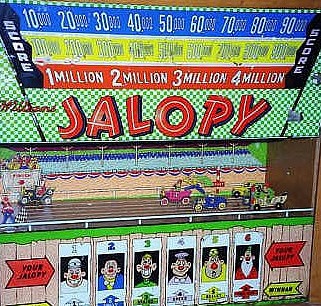
Williams’ 1951 classic, *Jalopy*, remains a quintessential piece of mid-century Americana, marking a high-water mark for the collaborative design efforts of industry titans Harry Williams and Sam Stern. Eschewing the complex electronics of the modern era, this electromechanical gem leans entirely into the raw, tactile joy of early pinball. The cabinet features the unmistakable, whimsical aesthetic of artist George Molentin, who captured the frenetic energy of early auto racing with a charm that defined the post-war arcade experience.
The machine’s true calling card is its mechanical backbox animation, a sophisticated feat of engineering for the time that transforms the score glass into a living, breathing race track. As players navigate the playfield, the backbox comes alive, mirroring the tension of a checkered-flag sprint. With a generous five-ball allotment for a nickel, the game encourages a fast-paced, aggressive style of play, challenging the operator to keep the ball in motion across the vibrant, uncluttered playfield to maximize the racing spectacle unfolding above.
While *Jalopy* lacks the deep rule sets of contemporary machines, its design philosophy centers on pure, rhythmic satisfaction. Success on this table demands a mastery of the early flipper geometry, requiring precise timing to bounce the ball between the playfield features and keep the backbox race progressing. It is a masterclass in simplicity, proving that even seven decades later, the combination of high-stakes racing themes and clever mechanical animation is more than enough to keep a player dropping nickels long after the race has been won.