
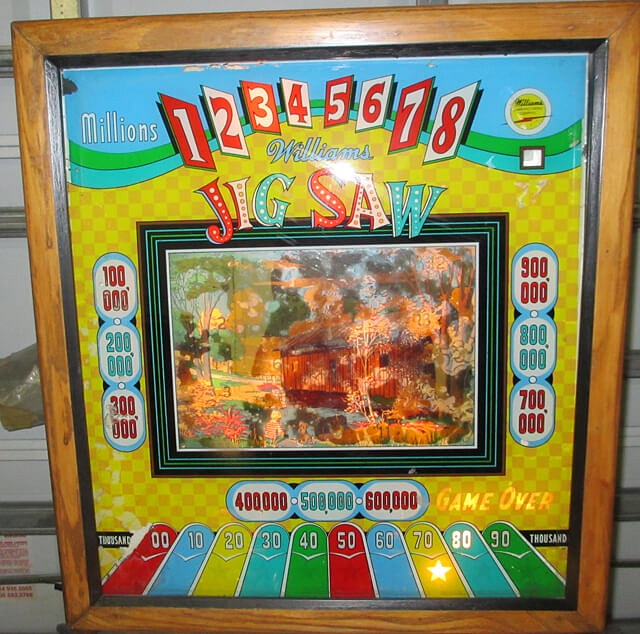
Jig Saw, released by Williams in 1957, stands as a quintessential piece of mid-century electromechanical design. Masterminded by the legendary Harry Williams and featuring the iconic, vibrant aesthetic of artist George Molentin, this single-player machine is a masterclass in minimalist playfield geometry. Unlike the cluttered, toy-heavy boards of the modern era, Jig Saw relies on pure, tactile feedback, utilizing a layout defined by two flippers, three active pop bumpers, and four passive bumpers that demand precision and anticipation from the player.
The playfield is anchored by two strategic kick-out holes and the titular gobble hole, a feature that acts as a high-stakes sinkhole for the wandering ball. Because the game utilizes light-based scoring rather than digital displays, the experience is entirely focused on the physical interaction between the steel ball and the playfield’s obstacles. Navigating the ball through the cluster of passive bumpers to find the kick-out holes requires a delicate touch; one wrong bounce off the slingshots can easily send your ball spiraling into the gobble hole, abruptly ending a promising run.
For the vintage enthusiast, Jig Saw represents the “golden age” transition period where pinball began to demand more than just luck. Success on this table is purely about mastering the rhythm of the flippers and controlling the ball’s momentum through the center of the board. It is a stripped-down, challenging experience that highlights the brilliant mechanical simplicity of the Williams era, proving that you don’t need complex modes or motorized toys to create a compelling, high-tension game of skill.