
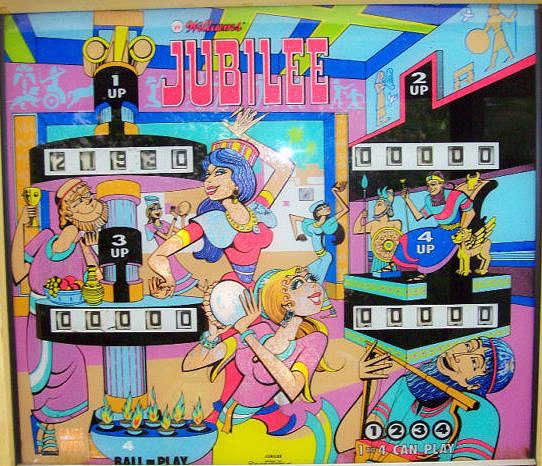
Williams’ 1973 release *Jubilee* stands as a quintessential artifact of the Steve Kordek era, blending the structural reliability of a four-player EM with the distinct, stylized aesthetics of artist Christian Marche. While Kordek is often celebrated for his pioneering work in game geometry, *Jubilee* leans into a lighthearted, travel-themed charm that feels classic, even by the standards of its time. With its dual-flipper layout and a pair of pop bumpers, the playfield is deceptively straightforward, yet it manages to capture that rhythmic, mechanical satisfaction that only a well-maintained Williams machine from the seventies can provide.
The standout mechanical allure of *Jubilee* is its reliance on five captive balls, which serve as the primary engine for building tension and scoring potential. Unlike the feature-heavy DMD machines that would follow decades later, this table relies on the physical feedback of these captive targets and strategic rollunder shots to keep the player engaged. Because of the relatively simple geometry, success on *Jubilee* relies heavily on precise flipper control and mastering the rebound angles off the pop bumpers. It is a game that rewards the patient player who learns to track the ball’s movement through the captive clusters, turning a seemingly simple setup into a high-stakes game of momentum management.
With over 7,000 units rolling off the production line, *Jubilee* was a staple of the arcade scene, serving as a reliable workhorse that offered accessible, competitive fun for up to four players. The design choices, from the specific placement of the rollover buttons to the dual ball kickers, reflect a designer who knew exactly how to balance frustration and reward. For the modern enthusiast, this machine is a masterclass in minimalism; it proves that you don’t need complex subways or motorized toys to create a compelling experience—just a clean playfield, a tight set of rules, and the perfect tension on the flippers.