
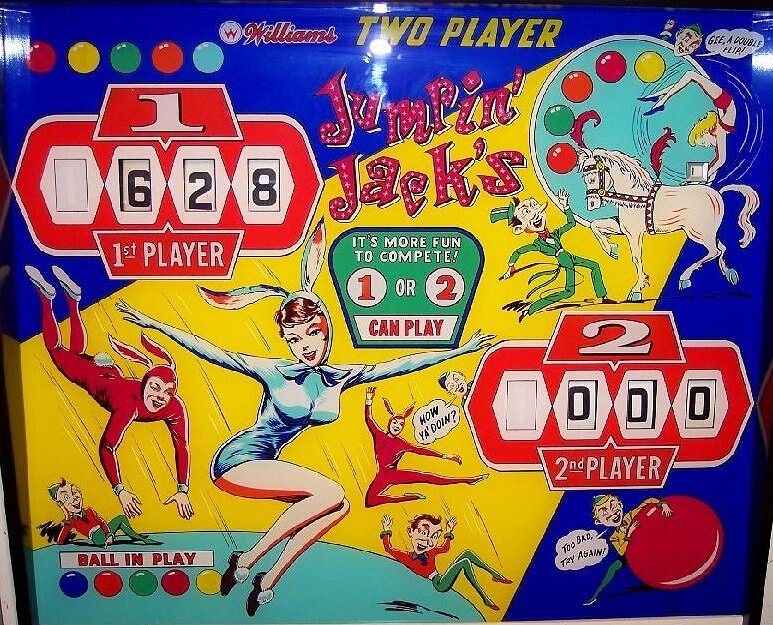
Jumpin’ Jack’s, released by Williams in 1963, stands as a quintessential example of Steve Kordek’s mastery over the early electromechanical era. Embracing a vibrant carnival theme, this two-player machine captures the kinetic, unpredictable spirit of the midway through its deceptively simple layout. Rather than relying on modern complexity, Kordek utilized a classic arrangement of two flippers, three pop bumpers, and a pair of passive bumpers to create a fast-paced experience that demands precise ball control despite the era’s limited tech.
The playfield is defined by its strategic use of high-risk scoring zones, most notably the dual gobble holes that lure players into testing their luck. Navigating the board requires careful aim to clear the two drop targets and trigger the five rollover buttons, which serve as the primary drivers for building up a respectable score. Because the game lacks the deep rulesets of later decades, success on Jumpin’ Jack’s relies entirely on mastering the geometry of the flippers and learning the specific rebound patterns off the passive bumpers.
With only 1,500 units ever produced, this machine remains a sought-after relic for collectors who appreciate the roots of arcade history. It is a quintessential “just one more game” experience, stripping away the bloat of modern modes to focus on pure, unadulterated shot-making. For the vintage enthusiast, Jumpin’ Jack’s isn’t just a piece of circus-themed nostalgia; it is a masterclass in how Kordek could transform a handful of mechanical switches and bumpers into a genuine test of skill.