
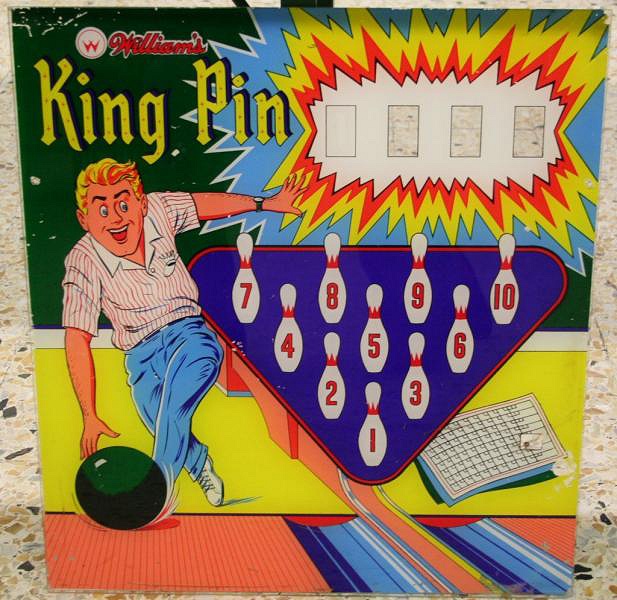
King Pin, released by Williams in 1962, stands as a quintessential piece of bowling-themed Americana from the golden age of electromechanical design. Penned by the legendary Norm Clark, this single-player machine strips away the flash of modern electronics to focus on the raw, tactile satisfaction of an old-school alley. With a layout featuring four flippers and a trio of pop bumpers, the playfield is engineered to mimic the chaotic, high-stakes trajectory of a bowling ball hurtling toward the pins, forcing the player to master precise shots to navigate the board’s unique geometry.
The mechanical heart of the game revolves around its pair of gobble holes, which serve as both a scoring challenge and a test of restraint. Because the playfield is prone to aggressive, unpredictable movement, the machine demands a defensive style of play. A seasoned operator knows to avoid the slingshots at all costs; their proximity to the outlanes creates a precarious “ping-pong” effect that frequently sends the ball careening straight into the drain. Success on King Pin requires a disciplined touch, keeping the action controlled and away from the edges to sustain a long, high-scoring run.
With only 1,250 units produced, King Pin remains a sought-after relic for collectors who appreciate the minimalist, high-difficulty design philosophy of the early sixties. By utilizing a kicker to keep the ball in play and rewarding players who can thread the needle between the standup targets, Clark crafted a machine that feels less like a pinball table and more like a high-tension frame at the local lanes. It is a masterclass in how limited features, when balanced correctly, can create an experience that is as punishing as it is rewarding.