
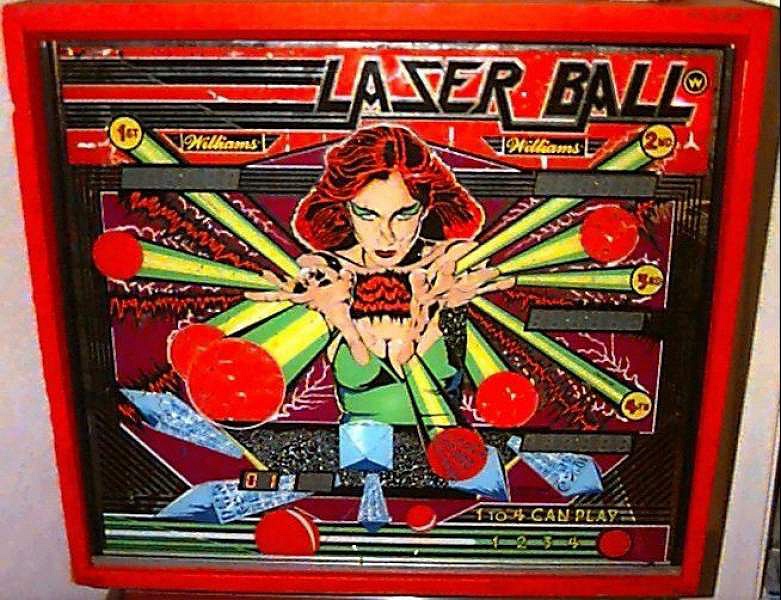
Blast off into the cosmos — Williams’ 1979 Laser Ball is an outer-space fantasy four-player designed by the prolific Barry Oursler, notable not least for its code by Eugene Jarvis, who would soon become a video-game legend with Defender and Robotron. With a healthy confirmed run of 4,500, this is a busy, target-rich early Williams solid-state: three flippers, three pops, ten star rollovers, three banks of drop targets, two spinners, twin kickback lanes, and more, all packed into one energetic playfield.
The strategy is a satisfying web of interlocking objectives. Making the B-A-L-L drop targets scores the “AE” value, ten thousand for each lit AE, while the bullseye and eject hole advance your “X” multiplier — and when five-times is lit, both spinners come alive for thousands. Lighting all ten star rollovers advances the AE value, and when the fifth AE is lit, the bullseye lights for an extra ball, with the sixth AE lighting it for a Special. Meanwhile, completing the L-A-S-E-R drop targets advances the laser value, and when twenty thousand is lit, making LASER lights the eject hole for an extra ball and the outlanes for Special. It’s a dense, layered scoring puzzle that rewards a player who tracks several threads at once.
Laser Ball is a terrific example of late-’70s Williams design at its most generous — loads of targets, multiple multiplier and value systems, and that fun cosmic theme, all touched by a future video-game icon’s code. For the collector who loves a deep classic with plenty to chase, it’s a gem. Spell your words, light your stars, climb the multipliers, and ride those spinners. The cosmos rewards the player who keeps every thread alive.