
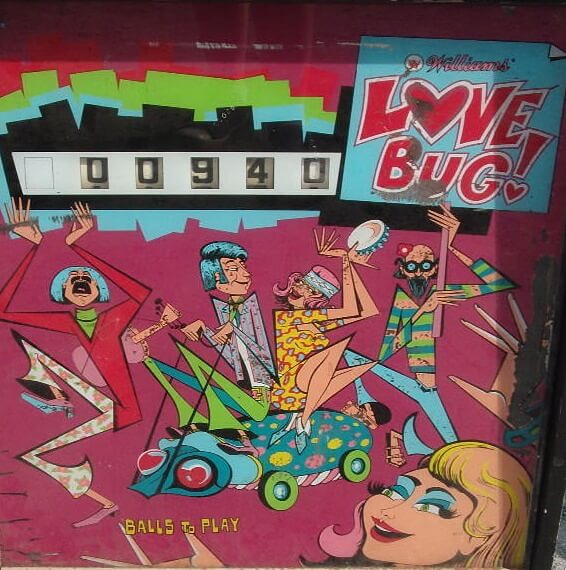
Love Bug, Williams’ 1971 electro-mechanical offering, is a vibrant Norm Clark design, brought to life with Christian Marche’s art, that immerses players in a world of dancing, happiness, and music. This single-player Add-A-Ball machine features a classic two-flipper layout, supported by five lively pop bumpers, two slingshots, and five standup targets that dot the playfield. A central kick-out hole and an up-post positioned strategically between the flippers offer both scoring opportunities and crucial ball saves. The game’s charm is amplified by its distinctive “Doodle Bug” mechanism, a signature feature that defines much of the strategic play.
The core of Love Bug’s gameplay revolves around activating and maximizing the “Doodle Bug” scoring. Initiating this feature requires a precise shot to the center standup target, which then triggers a continuous under-playfield ball scoring sequence. This unique mechanism awards points non-stop until the ball drains or it’s deliberately halted by hitting a side lane or an upper rubber. Players can dramatically increase the value of this continuous scoring from 10, to 100, then 1000, and finally a massive 10000 points, by skillfully hitting the lit standup targets. The 1-4 targets on the playfield are also instrumental, not only offering their own substantial points but also advancing the overall Doodle Bug progression, adding layers to the scoring strategy.
For tournament hopefuls and high-score chasers, mastering the “Doodle Bug” is paramount. A well-executed skill shot upon plunging can cycle the top awards, potentially lighting pop bumpers for big points or, most lucratively, landing on the far-right red award for a significant 5000 points—a game-changer in low-scoring EM contests. While letting the Doodle Bug run is often the goal, some strategists find value in repeatedly hitting the “Stop Doodle Bug” switches, which are worth 1000 points each, and quickly restarting the feature for consistent gains. Navigating the playfield requires finesse, especially around the flippers, as a notable gap between the flipper and sling makes traditional trapping difficult. Instead, players should rely on controlled flips to pick off targets and be ready to mash the flippers if the ball heads for the outhole, leveraging the up-post for last-ditch saves.