
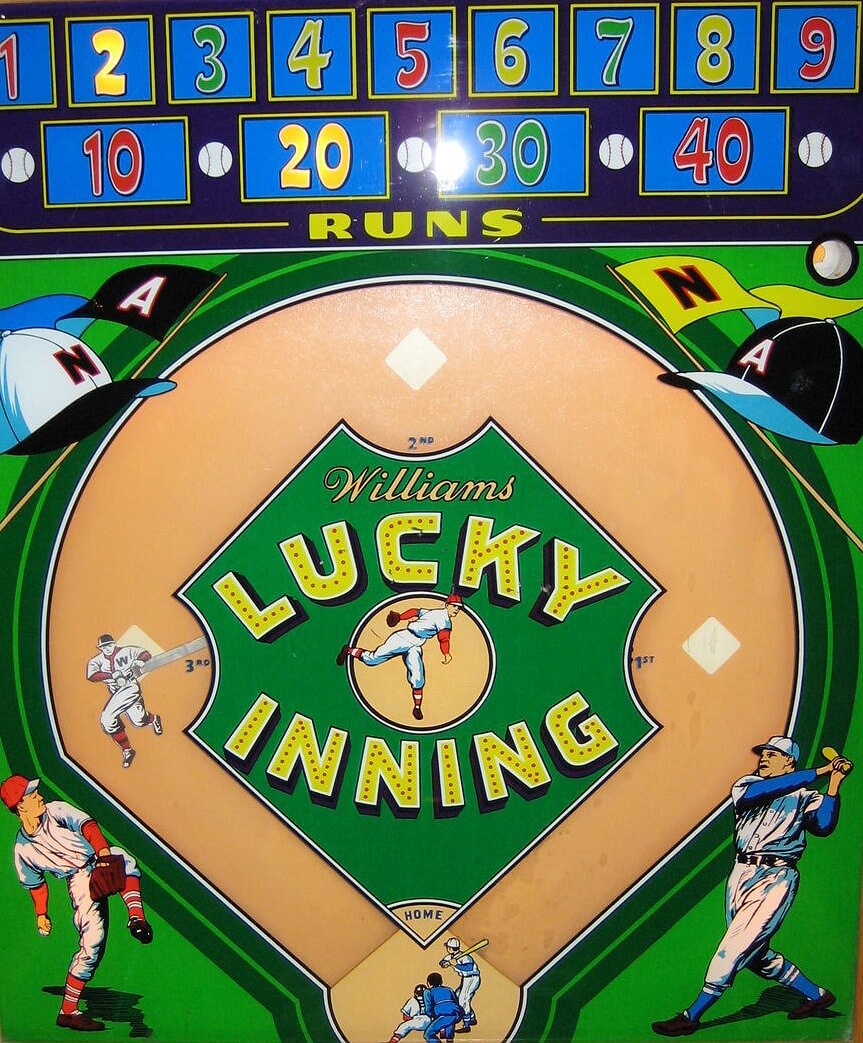
Lucky Inning, released by Williams in 1958, stands as a quintessential piece of mid-century Americana, capturing the golden age of baseball through the lens of electromechanical ingenuity. Designed by Gordon Horlick with vibrant, classic sports art by George Molentin, this machine transports players to the diamond with a simplicity that belies its addictive nature. As a classic EM, it eschews modern digital complexity for the tactile charm of relay-driven gameplay, offering a nostalgic experience where every flip of the bat feels like a high-stakes trip to the plate.
The machine’s primary draw is its mechanical backbox animation, a hallmark of Williams’ design prowess during the fifties. This feature serves as the visual theater of the game, tracking the action on the field as players work through their allotted five innings. With the standard setup of five innings for five cents, the game demands precision and consistency; there are no second chances in this league once your final inning concludes. It is a masterpiece of minimalist design, relying on the player’s ability to navigate the playfield to advance runners and rack up runs before the final out.
For those looking to master the diamond, success in Lucky Inning hinges on rhythm and timing. Because the game lacks the deep rulesets of modern machines, the strategy is intensely focused on shot repeatability and managing the tension of the inning. The art of the game lies in its pacing—the mechanical clicks and clacks of the scoring reels provide a rhythmic soundtrack that mirrors the slow-burn intensity of a real ballgame. It remains a prized acquisition for collectors who appreciate the purity of early sports-themed pinball, serving as a reminder that sometimes the most engaging play comes down to a single, well-placed shot.