
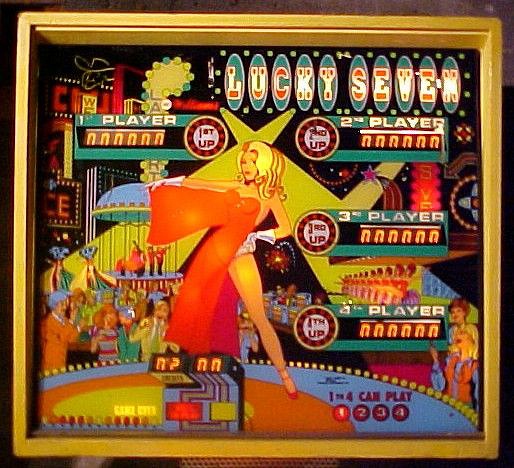
Lucky Seven, released by Williams in 1978, is a quintessential slice of late-seventies solid-state charm that leans heavily into the high-stakes aesthetic of a casino floor. Designed by Chris Otis with vibrant, unmistakable cabinet and playfield artwork by Christian Marche, the machine effectively transforms the pinball experience into a mechanical slot machine. The centerpiece of the design is the integrated playfield animation, which features actual slot machine reels housed beneath the playfield, forcing players to balance traditional ball control with the luck of the draw.
The gameplay loop is deceptively straightforward, revolving around the manipulation of these under-glass reels. By navigating the ball through the upper rollovers or striking the center standup targets, players cycle through reel combinations to determine the current jackpot value. Once you’ve dialed in a lucrative payout, the objective shifts to the pair of drop targets; clearing these locks in the prize, rewarding skilled shots over mindless flailing. It is a game of calculated risk, where the most valuable hands—such as triple sevens or diamonds—offer substantial point bonuses and extra balls, turning a standard session into a chase for the “big win.”
Tactical play on Lucky Seven requires a focus on the drop targets rather than the periphery. While the spinner may beckon with its rhythmic clicking, seasoned players often find it to be a negligible point-generator, even when fully lit. Instead, prioritize the targets to maximize the multiplier and bonus potential. With its four-player support and classic alphanumeric display, this machine remains a nostalgic, high-tension test of accuracy that captures the frantic energy of a Vegas strip in a compact, two-flipper package.