
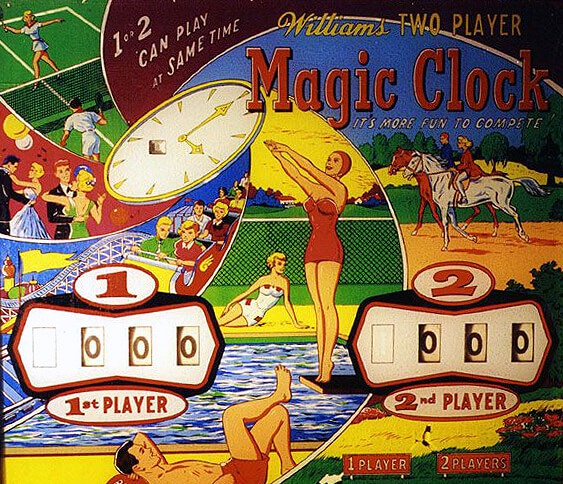
Magic Clock stands as a quintessential artifact of Williams’ mid-century production, a two-player electro-mechanical gem designed by the legendary Harry Mabs. With its charming theme centered on outdoor festivities and dance, this machine captures the simple, rhythmic joy of the golden era of pinball. Rather than relying on modern complexity, the game utilizes a classic two-flipper layout that demands precision, tasking players with navigating a playfield populated by a mix of active pop bumpers and passive bumpers that dictate the ball’s kinetic flow across the boards.
The centerpiece of the experience is the signature swinging target, a tactile feature that rewards the player’s timing and aim. Mabs’ design philosophy shines through in the interplay between the two slingshots and the strategic placement of the bumpers, which creates a frantic, unpredictable dance of its own. Because the game relies on traditional reel-based scoring, every successful shot against the swinging target feels like a major victory, echoing the high-stakes atmosphere of a late-night outdoor dance hall. It is a deceptively challenging machine that highlights the elegance of early mechanical engineering, proving that even without modern ramps or magnets, a well-tuned Mabs design can keep a player on their toes through sheer, rhythmic momentum.