
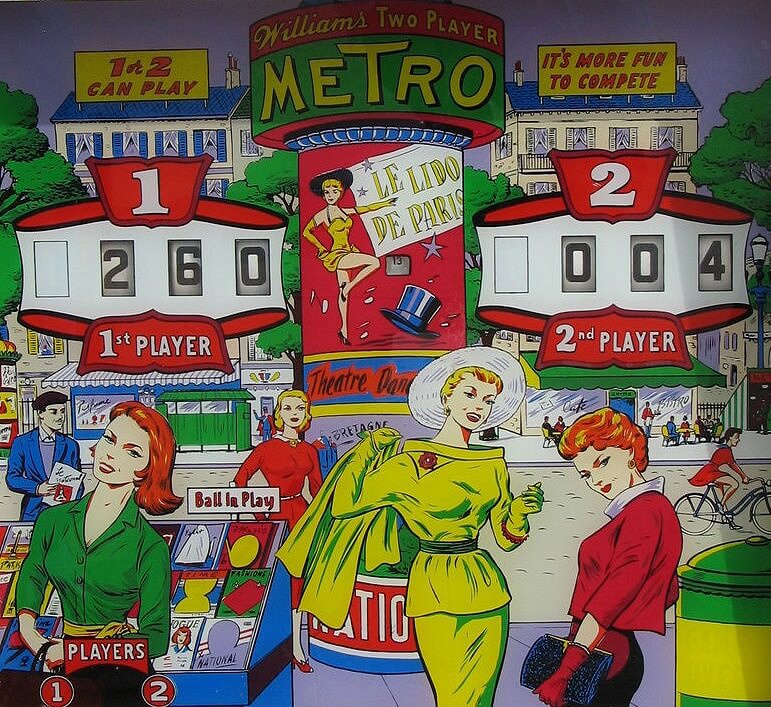
Metro, a 1961 release from Williams, stands as a quintessential artifact of the early electro-mechanical era, bearing the unmistakable fingerprints of legendary designer Steve Kordek. With art by George Molentin capturing the bustling, mid-century aesthetic of urban city living, this two-player machine is a study in minimalist design. Despite its modest production run of only 700 units, it remains a fascinating example of Kordek’s philosophy: prioritizing reliable, fast-paced play over the sprawling, toy-heavy layouts that would dominate the industry decades later.
The mechanical landscape of Metro is sparse but deliberate, utilizing a traditional two-flipper arrangement to navigate a grid of three active pop bumpers and four passive bumpers. The playfield is punctuated by a pair of strategic kick-out holes that demand precise ball control to keep the action moving. Because the machine relies on classic reel-based scoring, the experience is purely tactile; there is no digital hand-holding, only the rhythmic click of the relays and the satisfying thrum of the bumpers.
For players looking to master Metro, the key lies in managing the ball’s unpredictable trajectory off the passive bumpers. Unlike the active pop bumpers, which provide a predictable kick, the passive elements act as chaotic deflectors. Seasoned players should focus on rhythmic, controlled shots into the kick-out holes to maximize scoring potential, as the game’s limited geometry makes ball conservation the primary challenge. It is a no-frills, high-stakes test of timing that rewards players who can tame the erratic nature of a vintage urban commute.