
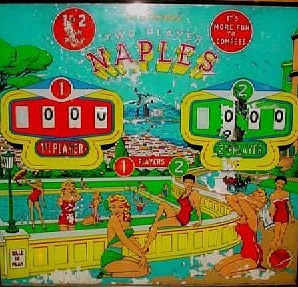
Naples, the 1957 classic from Williams, stands as a quintessential relic of the golden age of electromechanical pinball. Designed by the industry legend Harry Williams and brought to life with the distinct, mid-century aesthetic of artist George Molentin, this two-player machine captures the charm of a bygone era. At a time when a simple nickel bought you a full experience, the game relied on pure, rhythmic geometry rather than the complex digital toys of the modern era. Its design is a masterclass in minimalism, focusing on the tactile satisfaction of the playfield and the mechanical clatter of its score reels.
The gameplay experience is defined by the simplicity of the era, where the player’s focus is entirely on ball control and hitting targets to rack up points. Without the distraction of multi-ball modes or deep rule sets, Naples demands a rhythmic precision that feels surprisingly meditative. The playfield layout is sparse yet challenging, forcing players to master the timing of the flippers to navigate the ball through tight lanes. It is a testament to Williams’ philosophy that even with few features, a machine can remain endlessly replayable through the sheer difficulty of maintaining a high score.
For those looking to conquer this vintage gem, the strategy is rooted in patience and target management. Because the machine lacks the “save” features of modern pins, every shot must be calculated to avoid the dreaded center drain. Mastering the subtle bounce of the ball off the bumpers is essential for keeping your game alive and moving the score reels toward the next milestone. Naples isn’t just a game; it is a preserved slice of arcade history that rewards those who appreciate the raw, mechanical heart of pinball.