
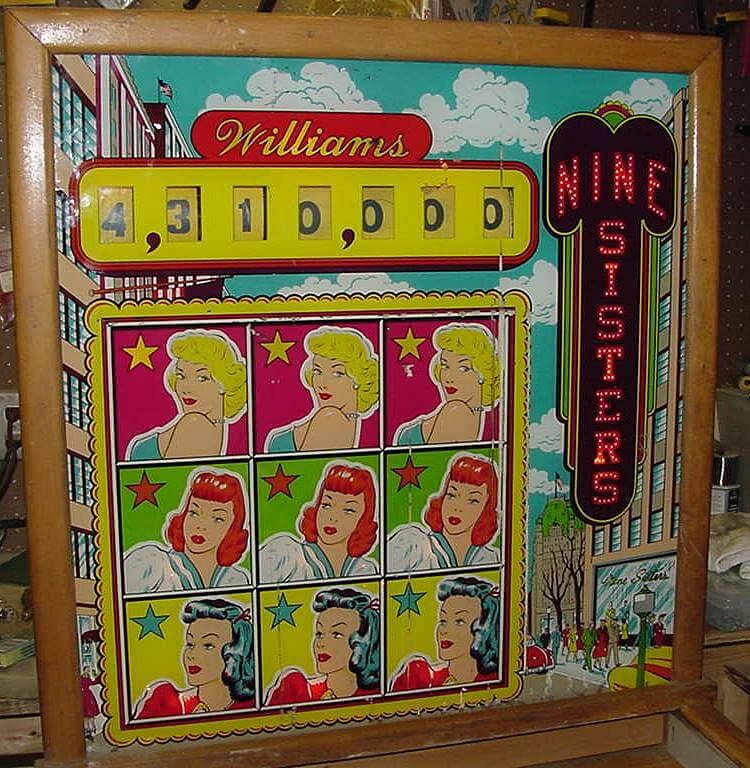
Nine Sisters, a classic 1953 release from Williams, stands as a quintessential artifact of the early electromechanical era, bearing the unmistakable design signature of industry legend Harry Williams. Featuring vibrant cabinet and playfield art by George Molentin, this single-player machine strips the pinball experience down to its most tactile, mechanical roots. Unlike the modern, multi-ball-heavy spectacles of today, this table relies on a precise, singular impulse flipper to navigate a board defined by its symmetry and reliance on gravity.
The playfield layout is a masterclass in mid-century geometry, centered around a trio of pop bumpers that provide the erratic, high-energy bounce characteristic of the period. The game’s primary challenge lies in mastering the four trap holes and two kick-out holes, which serve as the main scoring conduits. Navigating the kicker lanes requires a delicate touch, as the lack of modern ball-saving technology means every shot to the periphery carries the risk of a swift drain.
For the vintage enthusiast, Nine Sisters offers a lesson in early ball control and trajectory planning. Success on this machine is less about following a complex ruleset and more about understanding the specific physics of the impulse flipper; because the game lacks the sophisticated flow of modern ramps, players must learn to time their shots to hit the trap holes consistently to rack up a respectable score on the mechanical reels. It remains a stark, elegant reminder of the days when pinball design was defined by raw mechanical ingenuity rather than digital complexity.