
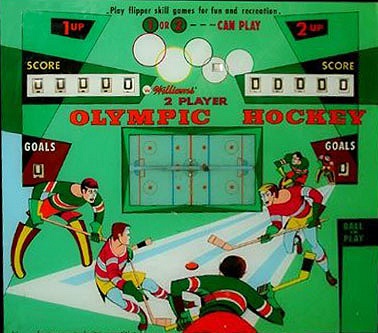
Olympic Hockey, released by Williams in 1972, stands as a quintessential piece of sports-themed electromechanical history. Designed by the legendary Steve Kordek and featuring the distinct, stylized artwork of Christian Marche, this two-player machine captures the grit and kinetic energy of the rink during an era when pinball was transitioning into its golden age. Its most striking feature is the mechanical backbox animation, which brings the thrill of the ice to the head of the machine, transforming the scoring process into a visual match between opposing teams.
The playfield layout is a classic Kordek construction, emphasizing precision over the chaotic clutter of modern designs. It utilizes a pair of snappy flippers to navigate a field populated by five active pop bumpers and a single passive bumper, creating erratic, high-speed bounces that mimic the unpredictable nature of a sliding puck. A critical mechanical inclusion is the up-post positioned between the flippers—a lifesaver for the tactical player looking to trap the ball and set up a clean shot—while the right outlane ball return gate offers a merciful second chance for those who play with aggressive, high-risk flipper techniques.
Despite its age, the game remains a masterclass in balance, relying on two primary standup targets to drive the scoring objectives. Because the machine lacks the complexity of modern multi-ball modes, success here relies on mastering the bounce patterns around the bumpers and utilizing the up-post to control the flow of the game. With only 2,555 units produced, it remains a sought-after relic for collectors who appreciate the tactile, rhythmic charm of reel-based scoring and the enduring legacy of Kordek’s minimalist approach to arcade design.