
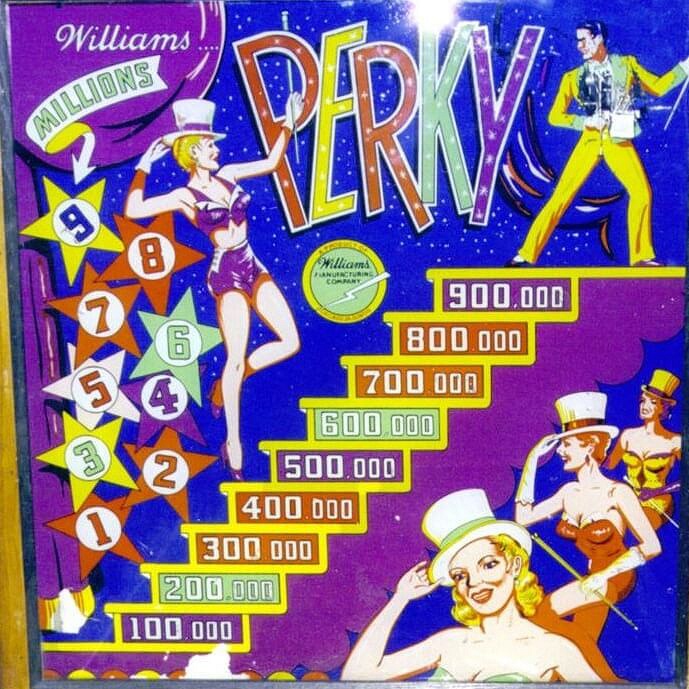
Perky, a 1950s classic from Williams, stands as a quintessential artifact of the early electromechanical era. Designed by the legendary Harry Williams and featuring the unmistakable, whimsically stylized art of Roy Parker, this single-player machine is a study in minimalist design and high-stakes precision. Unlike the ramp-heavy layouts of modern pins, Perky relies on a classic two-flipper configuration and a playfield dominated by the era’s signature “gobble hole” design, demanding surgical accuracy to navigate its straightforward but punishing geometry.
The gameplay experience is defined by the tension of those five strategically placed gobble holes. Rather than chasing complex modes or multiball jackpots, the player is locked in a direct contest with the machine’s layout. With three pop bumpers punctuating the action, the ball movement is frantic and unpredictable, frequently forcing the player to choose between conservative nudging and risky shots near the holes. It is a pure, visceral experience that prioritizes ball control and rhythmic timing over deep rulesets.
For the modern collector, Perky is a masterclass in the “less is more” philosophy that defined mid-century arcade culture. Because the machine lacks the sophisticated ball-save features or digital displays of today’s tech, success hinges entirely on understanding the specific bounce physics off the bumpers and the layout’s unique gravity. It is an essential piece for any archivist interested in the evolution of the game, serving as a reminder that before the era of magnets and motorized toys, the greatest challenge in pinball was simply keeping the ball out of the hole.