
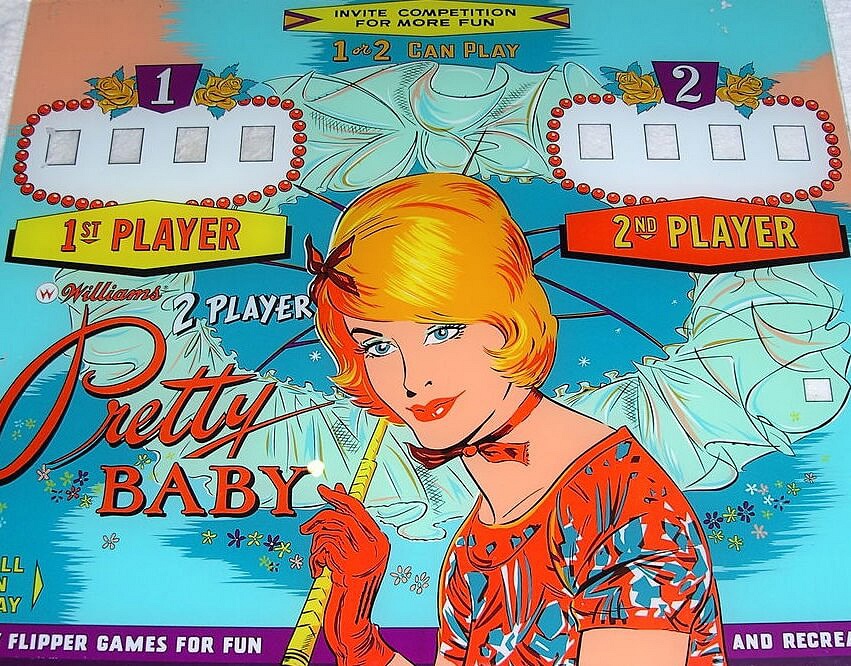
Pretty Baby, a 1965 release from Williams, stands as a quintessential artifact of the mid-sixties electromechanical era, bearing the unmistakable mark of legendary designer Steve Kordek. With a production run limited to just 1,300 units, this two-player machine leans heavily into the era’s classic aesthetic, trading complex modern rulesets for the straightforward, tactile satisfaction of an EM cabinet. Kordek’s layout is deceptively simple, utilizing a pair of flippers to navigate a playfield populated by three active pop bumpers, six passive bumpers, and a strategic arrangement of kick-out holes and drop targets.
The gameplay is defined by its vintage charm, relying on the rhythmic clicking of score reels and the unpredictable rebounds of passive bumpers to keep the action moving. While modern collectors often debate the merits of its minimalist design, the machine remains a fascinating study in early target-based scoring. Success on Pretty Baby requires mastering the two kick-out holes and timing your shots against the two drop targets; it’s a game that rewards precision over spectacle, offering a window into a time when arcade design was focused on pure, mechanical persistence.