
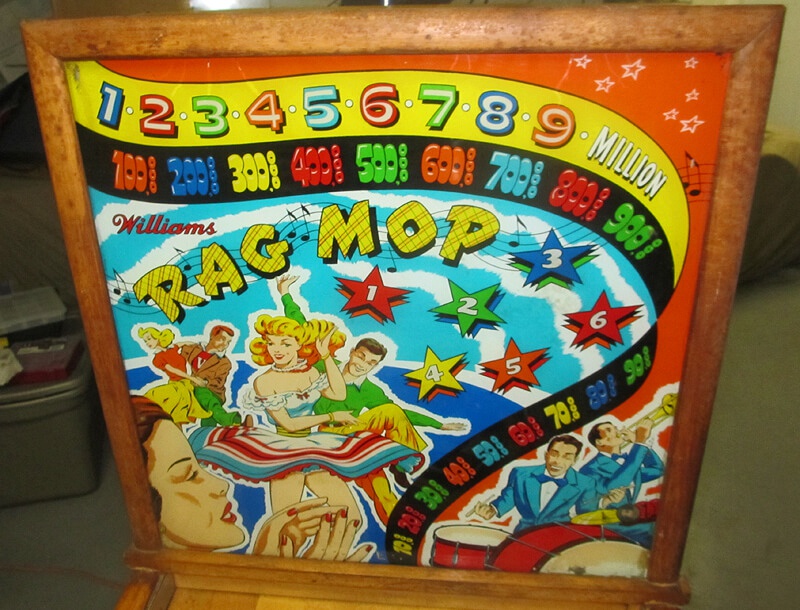
Rag Mop, released by Williams in 1950, stands as a quintessential artifact of the early post-war era, capturing the infectious energy of the titular novelty hit song. Designed by industry titan Harry Williams with vibrant, period-appropriate artwork by George Molentin, this single-player machine strips pinball down to its most rhythmic, mechanical essence. Eschewing the complex multi-level playfields of the modern era, Rag Mop relies on a minimalist approach centered around a single flipper, challenging players to master the art of the precision shot within a high-stakes, high-tension playfield.
The board layout is a masterclass in mid-century efficiency, featuring a quartet of kick-out holes that act as the primary scoring engines, complemented by a pair of active pop bumpers and a single passive bumper to disrupt the ball’s trajectory. The inclusion of a left-side kickback lane adds a surprising layer of defensive strategy, offering a rare second chance for a ball that would otherwise drain. Because the game lacks the redundant flipper arrays found in later decades, the flow is entirely dependent on the player’s ability to time their single-flipper actuation against the erratic, high-speed bounces provided by the bumpers.
For those looking to conquer this classic, success on Rag Mop is less about chasing complex rule sets and more about mastering the geometry of the kick-out holes. Players should focus on controlling the ball’s momentum as it exits the bumpers, aiming to cradle the rock-solid, singular flipper before attempting to bank shots into the scoring pockets. It is a game of patience and rhythm; treating the playfield as a dance floor—much like the song that inspired it—is the only way to keep the ball in motion and climb the high-score board on this challenging, unforgiving piece of arcade history.