
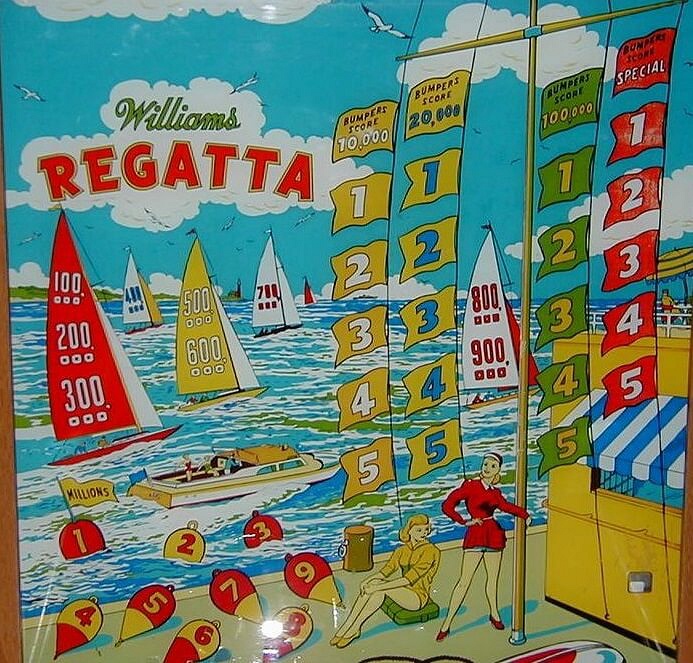
Regatta, a 1955 production from Williams, stands as a quintessential example of mid-century electromechanical design, masterminded by the legendary Harry Williams himself. With artwork by George Molentin, the table captures a breezy, coastal aesthetic centered on competitive boat racing and seaside leisure. Built for a single player, the machine eschews complex displays in favor of classic light-based scoring, demanding a sharp eye for the playfield’s rhythm rather than the digital feedback found in modern cabinets.
The mechanical layout is deceptively simple, relying on a pair of flippers and a strategic arrangement of two pop bumpers and five passive bumpers to keep the ball in play. The design emphasizes precision over raw speed, tasking the player with navigating the ball through a series of rollover buttons that serve as the primary drivers for building a competitive score. Because the playfield lacks the dense toy density of later eras, success in Regatta hinges on mastering the subtle, unpredictable bounces off the passive bumpers and timing your shots to hit the rollovers with consistency.
For the vintage enthusiast, this machine is a masterclass in the “less is more” philosophy that defined the golden age of Williams. Without the distraction of multiballs or deep rule sets, the game forces you to focus entirely on ball control and lane management. It remains a charming, high-stakes race against the clock and the gravity of the playfield, perfectly embodying the lighthearted but challenging spirit of 1950s arcade entertainment.