
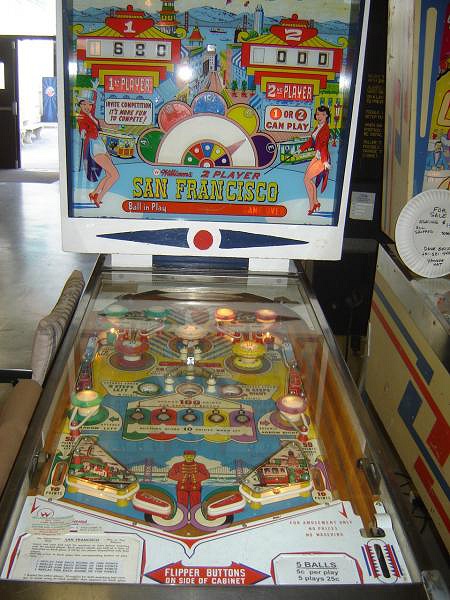
Williams’ 1964 classic San Francisco serves as a masterclass in mid-century mechanical design from the legendary Steve Kordek. As an Electromechanical (EM) title, it eschews digital complexity for pure, tactile charm, centered around the nostalgic theme of an American landmark. The machine’s most striking visual achievement is its mechanical backbox animation, a hallmark of the era that turns the scoreboard into a living, moving display. With a limited production run of 2,000 units, this table remains a coveted piece of history for those who appreciate the raw, rhythmic feedback of relay logic and spinning reels.
The playfield layout is quintessential Kordek, balancing two flippers against a dense arrangement of scoring features. Players must navigate a gauntlet of three jet bumpers and six passive bumpers that keep the ball in constant, unpredictable motion. The inclusion of two kick-out holes and a signature “gobble hole” adds a layer of risk-reward decision-making—a common, high-stakes trap found in the best games of the 1960s. The flow is punctuated by six rollover buttons and a rollunder, demanding precision shooting to maintain momentum across the two-player experience.
For the vintage enthusiast, mastering San Francisco requires an understanding of the board’s gravity-fed personality. Because the playfield features are heavily weighted toward bumpers and target-heavy zones, the key is to avoid the “drain-happy” nature of the lower exit lanes by utilizing controlled nudges. It is a game that rewards patience and rhythm rather than brute force, standing as a beautiful, mechanical relic that captures the spirit of San Francisco in a way only a 1960s Williams machine could.